
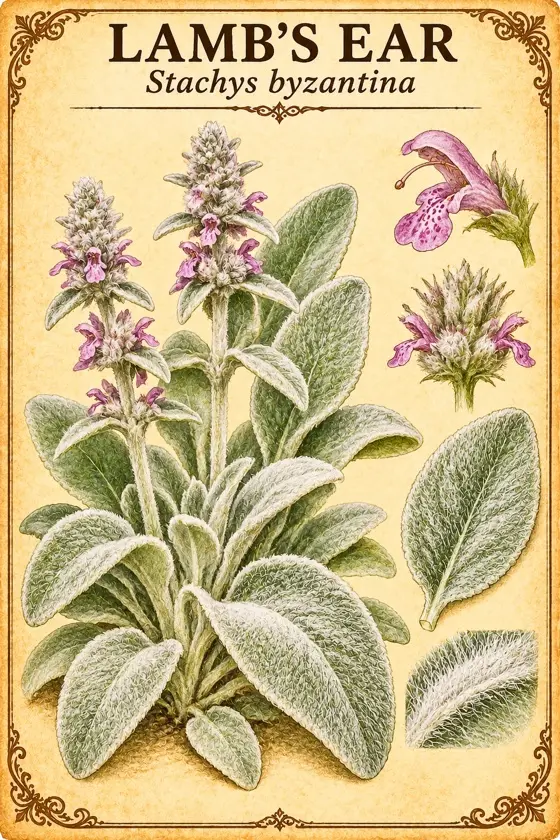
Lamb's Ear
Stachys byzantina
A silvery, woolly-leaved garden plant of the mint family, used in Iran for infected wounds and in Brazil as a tea and in cooking. Lab studies suggest skin and antioxidant benefits, but it hasn't been tested in people.
Safety at a glance
- PregnancyNothing recorded
- BreastfeedingNothing recorded
- MedicinesNothing recorded
- Who should avoid itNothing recorded
- Allergies1 note →
- Toxicity1 note →
Tap a box to read the safety notes below. “Nothing recorded” means our sources don't cover it, not that it's safe.
What is Lamb's Ear?
- Plant family
- Lamiaceae, the mint family
- Parts used
- The woolly leaves (aerial parts)
- Where it grows
- Turkey, the Caucasus, Armenia and northern Iran; grown in gardens worldwide
- Genus
- Stachys
- Species
- byzantina
Also called
Lambs Ear, Woolly Hedgenettle
Traditional names
Peixinho da Horta
Older scientific names
Stachys lanata
Traditionally used for
- Infected wounds (traditional)
- Inflammation (traditional)
- Skin ageing and dark spots (lab research)
Traditionally described as
- Leaves rich in verbascoside and chlorogenic acid
Health topics
Where Lamb's Ear appears in symptom search, and why. Being listed doesn't mean it's a proven treatment.
- Cancer Research
Leaf extracts slowed several cancer cell types in the lab.
- Cuts, Wounds, Burns and Skin Ulcers
Used in Iran as a decoction for infected wounds; its genus is known as woundwort.
- Scars, Wrinkles and Skin Aging
Lab tests suggest it may help dark spots and skin ageing.
Natural compounds
How it's prepared
Common ways Lamb's Ear is prepared or sold. This isn't advice on how to take it; see Safety below.
- Culinary Preparation
Used in cooking and valued as a source of nutrients.[1]Study
- Decoction
Used in Iran as a decoction for infected wounds.[2]Review or trial
- Poultice
Fresh leaves are crushed and laid on minor cuts and stings as a folk bandage.[3]General reference
- Tea / Infusion
Drunk as a tea in Brazil to reduce inflammation.[2]Review or trial
Safety
Allergies
The woolly hairs on the leaves may irritate sensitive skin, and some people may be allergic. Try it on a small patch of skin first. Don't rely on it for deep wounds or wounds showing signs of infection.
This advice comes from a general web article, not from research.[4]General reference
Toxicity testing
In lab tests, lamb's ear leaf extracts weren't toxic to human skin cells or other normal cells at the strengths tested. However, there are no safety studies in people.[5]Study
Technical detail: no cytotoxicity in HaCaT keratinocytes up to 200 µg/mL; none in umbilical cord cells or murine fibroblasts.
Contamination
Lamb's ear can be confused with mullein, another plant with soft, silvery, fuzzy leaves. Lamb's ear grows low and spreads into mats, with tongue-shaped leaves and purple-pink flowers. Mullein grows a tall spike of yellow flowers in its second year and has much bigger leaves.[4]General reference
What does the research say?
Traditional use
These are traditional uses, not proven treatments.
Lamb's ear is a low-growing plant of the mint family, named for its thick, silvery leaves that feel as soft as a lamb's ear. It belongs to the genus Stachys, whose plants are often called "woundworts" because they were applied to heal wounds in ancient traditions.
In Iran, a decoction of lamb's ear is used to treat infected wounds. In Brazil, it's drunk as a tea to reduce inflammation.[2]Review or trial
In Brazil, where lamb's ear is called peixinho da horta ("little garden fish"), its leaf extract has been tested as a natural antioxidant to keep fresh pork sausages from spoiling, working about as well as a synthetic additive.[6]Study
Technical detail: 0.5% extract gave TBARS values similar to the synthetic antioxidant control over 16 days.
Lamb's ear's soft, woolly leaves have long been laid on cuts and sore skin as a natural bandage, sometimes crushed first into a poultice. In one reader's report, a fresh leaf placed on a sore, infected finger eased the pain within minutes. This is folk use and personal experience, not tested treatment.[3]General reference
The leaves are edible. Young leaves can be eaten raw in salads, and larger ones steamed as a green or battered and fried. Their flavor is described as mild, somewhat like cucumber.
This comes from a general web article, not from research.[4]General reference
Laboratory & animal research
Lab and animal results show what might be worth studying in people. They don't show that the herb has these effects in humans.
In lab tests, lamb's ear extracts blocked tyrosinase, the enzyme that makes skin pigment, and slowed enzymes that break down the skin's support structure. They also acted as antioxidants and absorbed UV light. The authors suggest it could be a cosmetic ingredient for dark spots and skin ageing, but it hasn't been tested on people.[7]Study
Technical detail: dichloromethane fraction IC50 63.5 µg/mL (tyrosinase), 369 µg/mL (hyaluronidase), 40% elastase inhibition at 500 µg/mL; rich in verbascoside (204 mg/g) and chlorogenic acid (24 mg/g).
Lamb's ear is used in cooking as well as in folk medicine. In lab tests, leaf extracts slowed the growth of brain tumor (glioma), breast cancer and melanoma cells, without harming normal cells. The leaves contain healthy fats such as alpha-linolenic acid, along with vitamin E and carotenoids.[1]Study
Technical detail: hexane extract active against glioma, breast adenocarcinoma and murine melanoma; hydroethanolic and hydroacetone extracts active against melanoma; sulforhodamine B assay.
In short
No human safety studies; extracts weren't toxic to cells in the lab.
Sources
- [1] Bioactive fatty acids and anticancer potential of leaf extracts from Stachys byzantina K. Koch · DOI: 10.1590/1519-6984.300070Peer-reviewed study
- [2] Genus Stachys—Phytochemistry, Traditional Medicinal Uses, and Future Perspectives · DOI: 10.3390/molecules29225345Review or clinical trial
- [3] Sore Infected Finger Responds to Lambs Ear Leaf — The People's PharmacyGeneral reference
- [4] Lambs ear: the biological bandage (web article; exact page address not available) — projectxeros.orgGeneral reference
- [5] Ethanolic Extract of Stachys byzantina Leaf: Optimization of Ultrasonic Probe-Assisted Extraction and Characterization · DOI: 10.3390/plants14233636Peer-reviewed study
- [6] Lipid Oxidative Stability of Fresh Pork Sausages Enriched With Peixinho Da Horta (Stachys byzantina K. Koch) Extracts Obtained via Natural Deep Eutectic Solvents (NADES) · DOI: 10.1111/1750-3841.70345Peer-reviewed study
- [7] Stachys byzantina K. Koch (Lamiaceae) as a potential ingredient for delaying skin ageing and treating hyperpigmentation disorders in pharmaceutical products · DOI: 10.1093/jpp/rgae138Peer-reviewed study
This information is educational and traditional in nature, and is not a substitute for professional medical advice. Unfamiliar word? See what these words mean.