
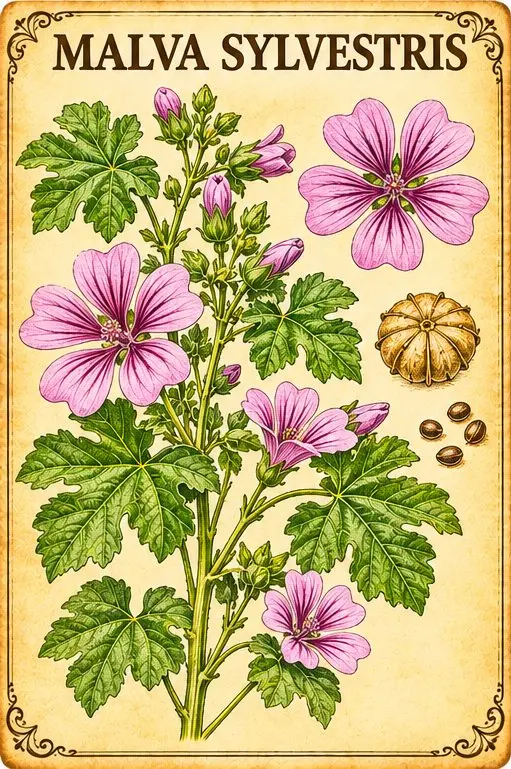
Malva Sylvestris
Malva sylvestris
Common mallow, whose flowers and leaves are recognized in Europe as a soothing traditional tea for sore throat, dry cough and mild stomach upset.
Safety at a glance
- Pregnancy1 note →
- BreastfeedingNothing recorded
- MedicinesNothing recorded
- Who should avoid it1 note →
- Allergies1 note →
- ToxicityNothing recorded
Tap a box to read the safety notes below. “Nothing recorded” means our sources don't cover it, not that it's safe.
What is Malva Sylvestris?
- Plant family
- Malvaceae, the mallow family
- Parts used
- The flowers and leaves, as a tea
- Genus
- Malva
- Species
- sylvestris
Also called
Mallow, Mallow Flower, Mallow Leaf
Traditionally used for
- Sore throat
- Dry cough
- Mild stomach discomfort
Traditionally described as
- Soothing flowers and leaves
Health topics
Where Malva Sylvestris appears in symptom search, and why. Being listed doesn't mean it's a proven treatment.
- Cough
Recognized in Europe as a traditional soothing tea for the dry cough that comes with throat irritation.
- Indigestion
Recognized in Europe as a traditional soothing tea for mild stomach and gut discomfort.
- Sore Throat
Recognized in Europe as a traditional soothing tea for mouth and throat irritation.
Traditions that use it
- European Folk Medicine
Its flowers and leaves are recognized in the European Union as a traditional soothing medicine for mouth and throat irritation with dry cough, and mild stomach discomfort.
Safety
Who should avoid it
Not for children under 12. For throat symptoms, see a doctor if you become short of breath, get a fever or cough up pus, or if symptoms last longer than 1 week. For stomach discomfort, see a doctor if it lasts longer than 2 weeks.[1]Health agency
Allergies
Don't use mallow if you are allergic to it.[1]Health agency
Side effects
No side effects are known. No interactions with medicines have been reported.[1]Health agency
Pregnancy
Its safety in pregnancy and breastfeeding has not been established, so it is not recommended during pregnancy or while breastfeeding.[1]Health agency
How much to use
Ages 12 and up:
- Flowers: 1 to 2 g in 250 ml of boiling water as a tea, 2 to 3 times a day (about 5 g a day).
- Leaves: 1.8 g in 150 ml of boiling water as a tea, 3 times a day (5.4 g a day).
What does the research say?
Traditional use
These are traditional uses, not proven treatments.
The European Medicines Agency recognizes mallow flowers and leaves as a traditional soothing herbal medicine for ages 12 and up, based on long-standing use:
- for irritation of the mouth or throat and the dry cough that comes with it
- for mild stomach and gut discomfort
There are no studies of mallow in patients.[3]Health agency
Laboratory & animal research
Lab and animal results show what might be worth studying in people. They don't show that the herb has these effects in humans.
Lab studies have shown that mallow flower preparations reduce coughing and inflammation, and that mallow leaf reduces inflammation.[3]Health agency
In short
Ages 12+; not in pregnancy.
Sources
- [1] European Union herbal monograph on Malva sylvestris L., flos (EMA/HMPC/749511/2016) — European Medicines Agency, Committee on Herbal Medicinal Products (HMPC)Government health agency
- [2] European Union herbal monograph on Malva sylvestris L. and/or Malva neglecta Wallr., folium (EMA/HMPC/749510/2016) — European Medicines Agency, Committee on Herbal Medicinal Products (HMPC)Government health agency
- [3] Mallow flower: summary for the public (EMA/836527/2018) — European Medicines Agency, Committee on Herbal Medicinal Products (HMPC)Government health agency
This information is educational and traditional in nature, and is not a substitute for professional medical advice. Unfamiliar word? See what these words mean.