
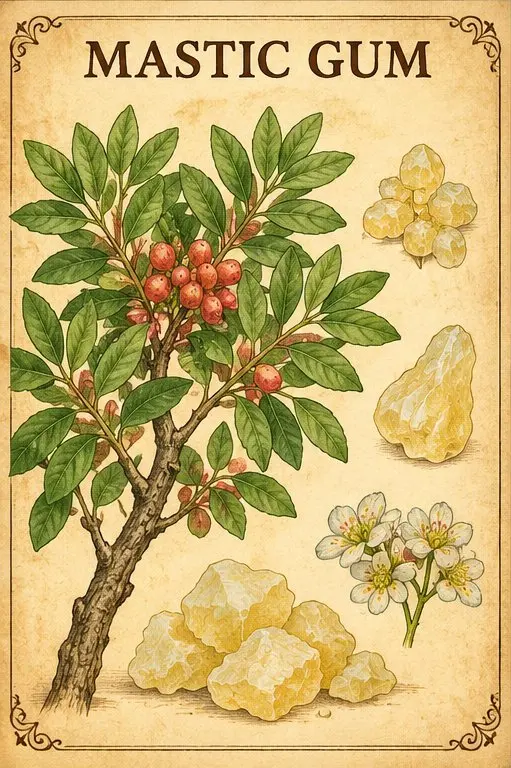
Mastic Gum
Pistacia lentiscus
A tree resin recognized in Europe as a traditional medicine for mild indigestion and minor skin problems.
Safety at a glance
- Pregnancy1 note →
- BreastfeedingNothing recorded
- MedicinesNothing recorded
- Who should avoid itNothing recorded
- Allergies1 note →
- ToxicityNothing recorded
Tap a box to read the safety notes below. “Nothing recorded” means our sources don't cover it, not that it's safe.
What is Mastic Gum?
- Plant family
- Anacardiaceae, the cashew and mango family
- Parts used
- The resin (a gum that seeps from the tree's bark)
- Genus
- Pistacia
- Species
- lentiscus
Also called
Mastic, Chios Mastic Gum
Traditionally used for
- Mild indigestion
- Minor skin inflammation
- Small wounds
Traditionally described as
- Tree resin
Health topics
Where Mastic Gum appears in symptom search, and why. Being listed doesn't mean it's a proven treatment.
- Cuts, Wounds, Burns and Skin Ulcers
Recognized in Europe as a traditional skin preparation to help small wounds heal.
- Indigestion
Recognized in Europe as a traditional medicine for mild indigestion; one trial found it eased ongoing indigestion.
- Skin Irritation, Rashes and Itching
Recognized in Europe as a traditional skin preparation for minor skin inflammation.
Traditions that use it
- European Folk Medicine
Recognized in the European Union as a traditional herbal medicine for mild indigestion, and on the skin for minor inflammation and small wounds.
Safety
Allergies
Don't use mastic if you are allergic to it.[1]Health agency
Side effects
No side effects are known. No interactions with medicines have been reported.[1]Health agency
Pregnancy
Its safety in pregnancy and breastfeeding has not been established, so it is not recommended during pregnancy or while breastfeeding.[1]Health agency
How much to use
For indigestion: adults only (not for anyone under 18), 0.5 to 1 g twice a day. See a doctor if symptoms last longer than 2 weeks.
On the skin: for ages 12 and up, a thin layer of a cream or ointment up to 3 times a day. See a doctor if symptoms last longer than 1 week, get worse, or there are signs of skin infection.[1]Health agency
Technical detail: skin preparations contain 9–11% powdered resin; daily oral dose 1–2 g.
What does the research say?
Traditional use
These are traditional uses, not proven treatments.
The European Medicines Agency recognizes mastic as a traditional herbal medicine for two uses, based on long-standing use rather than proof from clinical trials:
- taken by mouth for mild indigestion
- applied to the skin for minor skin inflammation and to help small wounds heal
Research in people
In a 2010 trial, 148 people with ongoing indigestion that had no clear cause took mastic gum or a placebo for 3 weeks. Their symptoms improved significantly more with mastic.[2]Study
Technical detail: functional dyspepsia; 350 mg three times daily for 3 weeks; randomized, double-blind, placebo-controlled.
In a small 2026 trial, 64 people with H. pylori (a stomach infection that can cause ulcers) took standard antibiotic treatment with or without mastic gum. Adding mastic did not clearly clear the infection more often, but indigestion symptoms improved more.[3]Study
Technical detail: added to bismuth quadruple therapy; eradication 85% vs 67%, not statistically significant; single-blind pilot study.
In short
Adults only by mouth; not in pregnancy or breastfeeding.
Sources
- [1] European Union herbal monograph on Pistacia lentiscus L., resina (mastic) (EMA/HMPC/46758/2015) — European Medicines Agency, Committee on Herbal Medicinal Products (HMPC)Government health agency
- [2] Is Chios mastic gum effective in the treatment of functional dyspepsia? A prospective randomised double-blind placebo controlled trial · DOI: 10.1016/j.jep.2009.11.021Peer-reviewed study
- [3] Mastic gum as an adjunct therapy to standard bismuth quadruple therapy for Helicobacter pylori eradication: A randomized single-blind pilot study · DOI: 10.1007/s12664-026-01968-8Peer-reviewed study
This information is educational and traditional in nature, and is not a substitute for professional medical advice. Unfamiliar word? See what these words mean.