
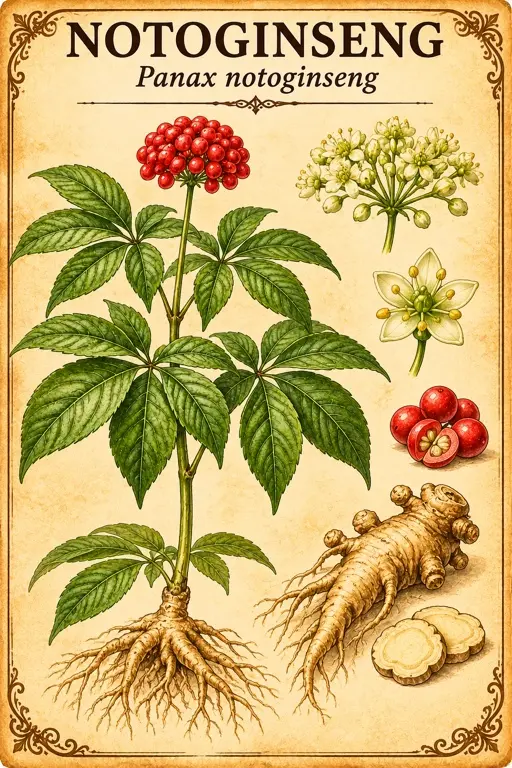
Notoginseng
Panax notoginseng
A ginseng relative from southwest China whose root, san qi, is a leading Chinese remedy for bleeding, bruising and circulation. Trials in stroke and lung disease are mostly small or low quality, and it can affect blood clotting.
Safety at a glance
- Pregnancy1 note →
- BreastfeedingNothing recorded
- Medicines1 note →
- Who should avoid itNothing recorded
- AllergiesNothing recorded
- Toxicity1 note →
Tap a box to read the safety notes below. “Nothing recorded” means our sources don't cover it, not that it's safe.
Notoginseng may interact with some medicines. If you take any medicine, read Interactions with medicines below and talk to your doctor or pharmacist before using it.
What is Notoginseng?
- Plant family
- Araliaceae, the ginseng family
- Parts used
- The root
- Where it grows
- Southwest China
- Genus
- Panax
- Species
- notoginseng
Also called
Sanchi, Tienchi Ginseng
Traditional names
San Qi, Tian Qi
Traditionally used for
- Bleeding from injuries
- Bruises and swelling
- Heart and circulation (traditional)
- Stroke recovery (studied)
Traditionally described as
- Rich in saponins (ginsenosides and notoginsenosides)
Health topics
Where Notoginseng appears in symptom search, and why. Being listed doesn't mean it's a proven treatment.
- Cuts, Wounds, Burns and Skin Ulcers
Traditionally used in Chinese medicine to stop bleeding from injuries. Note that a steamed extract slowed clotting in rats.
- Poor Circulation
Used in China for heart and circulation problems; a Cochrane review of stroke trials found possible benefit but poor-quality evidence.
- Sprains and Bruises
A traditional Chinese remedy for injuries, bruising, pain and swelling.
Traditions that use it
- Traditional Chinese Medicine
A leading Chinese herb (san qi) for bleeding from injuries, bruising, pain and swelling, and for heart and circulation problems.
Safety
Interactions with medicines
Notoginseng can slow blood clotting. Some studies report important interactions with blood thinners, including:
- Anticoagulants (such as warfarin)
- Antiplatelet medicines (such as aspirin or clopidogrel)
In rats it raised the amount of aspirin in the blood. This hasn't been proven in people, but it may raise the risk of bleeding in people taking low-dose aspirin.[1]Study
Technical detail: saponins increased the systemic bioavailability of acetylsalicylic acid in Sprague-Dawley rats by increasing its transport across cell membranes. Saponins are metabolized mainly by CYP3A4; reported effects on CYP2C9, CYP2C19, CYP2B6 and CYP2E1 were negligible.
Pregnancy
Its safety in pregnancy hasn't been established. Europe's food safety agency judged a mixed extract of notoginseng and astragalus safe at a low daily amount for adults, but excluded pregnant women.[1]Study
Technical detail: EFSA (2020) considered the combined Panax notoginseng and Astragalus membranaceus extract safe at 0.5 mg/kg/day in adults, excluding pregnant women.
Toxicity testing
Its toxicity hasn't been well studied. In zebrafish larvae, extracts were toxic at higher doses, and a boiled extract caused growth problems. A 90-day rat study and other reports found almost no toxic effects. The review says more safety studies are needed before it can be properly tested in people.[1]Study
Technical detail: LD50 in zebrafish larvae 73.8 µg/mL (raw) and 151 µg/mL (decocted); developmental abnormalities after 21 days with the decocted extract. Rat sub-chronic study: 0.75–7.5 g/kg/day powder for 90 days.
What does the research say?
Traditional use
These are traditional uses, not proven treatments.
Notoginseng, known in China as san qi or tian qi, grows mainly in the southwest of the country. In traditional Chinese medicine the root is used for:
- Bleeding inside or outside the body after an injury
- Injuries and bruising
- Pain and swelling
- Heart and circulation problems
Technical detail: traditionally used for cardiovascular diseases, pain, inflammation, trauma, and internal and external bleeding due to injury.
Notoginseng has long held a leading place in Chinese medicine. It's valued for boosting energy and stamina, sharpening the mind and helping the body cope with stress.[1]Study
Technical detail: described as ergogenic, nootropic and antistress.
Laboratory & animal research
Lab and animal results show what might be worth studying in people. They don't show that the herb has these effects in humans.
More than 200 natural compounds have been found in the plant, mainly saponins (the same family as ginseng's ginsenosides). In lab and animal studies, it has shown effects on the heart and blood vessels and the immune system. It has also been studied for reducing inflammation, slowing artery hardening, stopping bleeding, and acting against tumors.[2]Study
Technical detail: constituents include saponins, flavonoids and cyclopeptides; reported activities include anti-inflammatory, anti-atherosclerotic, haemostatic and antitumour effects.
Steaming the root changes its chemistry. In rats, a steamed extract slowed blood clotting and made bleeding last longer than the raw extract did. Its effect on clotting cells was similar to a dose of aspirin.[1]Study
Technical detail: steamed extract 500 mg/kg orally inhibited platelet aggregation and prolonged bleeding time more than raw extract; platelet inhibition was not significantly different from 25 mg/kg acetylsalicylic acid.
Research in people
A Cochrane review found 8 trials with 660 people given sanchi soon after a stroke caused by a blood clot. Sanchi seemed to improve nerve and movement problems. In 2 trials, fewer people died or needed daily help after 28 days.
But 7 of the 8 trials were of poor quality, and most strokes were mild. So no firm conclusion could be drawn. Few side effects were reported.[3]Review or trial
Technical detail: randomized trials of sanchi vs placebo or no treatment within 30 days of acute ischaemic stroke. Death or dependency RR 0.63 (95% CI 0.45 to 0.88; 2 trials); neurological deficit improvement RR 0.29 (95% CI 0.18 to 0.47; 7 trials). Case fatality under 1%.
A 2024 review pooled 20 trials with 1,831 people with COPD (a long-term lung disease) and thickened blood. Notoginseng saponin products, given alongside usual care, improved breathing tests, blood oxygen and signs of blood thickness.[4]Review or trial
Technical detail: improvements in FEV1% predicted, FEV1/FVC, fibrinogen, D-dimer, whole blood and plasma viscosity, PaO2 and PaCO2. Activated partial thromboplastin time and prothrombin time did not change significantly. Trials used Panax notoginseng saponin (PNS) preparations.
A 2024 review found that few studies in people have confirmed notoginseng's benefits. Most used it alongside standard treatment for heart and blood vessel disease.[1]Study
In short
May interact with blood thinners such as warfarin and aspirin. Safety in pregnancy hasn't been established.
Sources
- [1] Panax notoginseng: Pharmacological Aspects and Toxicological Issues · DOI: 10.3390/nu16132120Peer-reviewed study
- [2] Traditional uses, botany, phytochemistry, pharmacology and toxicology of Panax notoginseng (Burk.) F.H. Chen: A review · DOI: 10.1016/j.jep.2016.05.005Peer-reviewed study
- [3] Sanchi for acute ischaemic stroke · DOI: 10.1002/14651858.CD006305.pub2Review or clinical trial
- [4] Clinical efficacy and safety of Panax notoginseng saponins in treating chronic obstructive pulmonary disease with blood hypercoagulability: A meta-analysis of randomized controlled trials · DOI: 10.1016/j.phymed.2023.155244Review or clinical trial
This information is educational and traditional in nature, and is not a substitute for professional medical advice. Unfamiliar word? See what these words mean.