
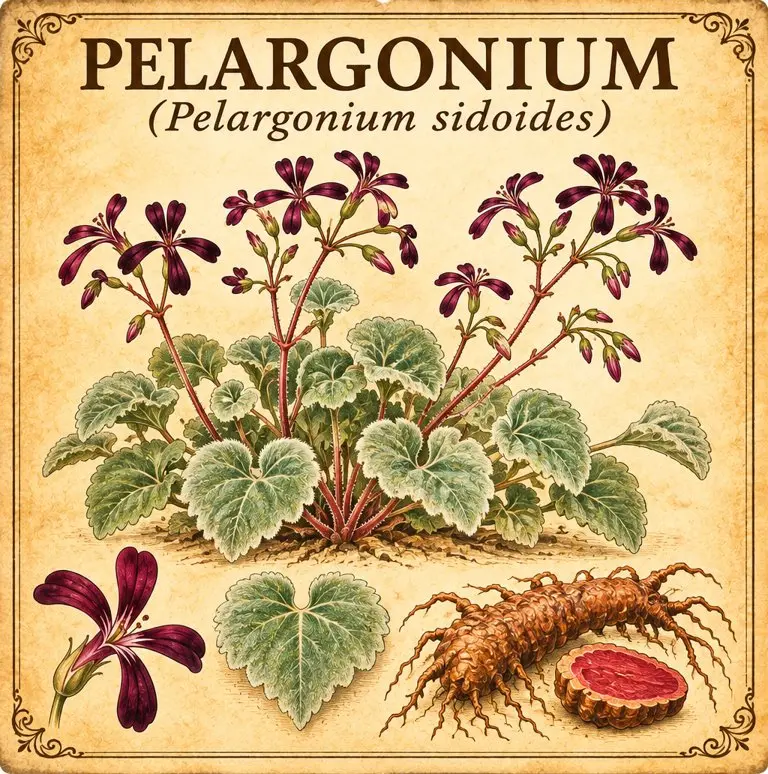
Pelargonium
Pelargonium sidoides
A South African plant whose root extract is recognized in Europe as a traditional medicine for common cold symptoms.
Safety at a glance
- PregnancyNothing recorded
- BreastfeedingNothing recorded
- MedicinesNothing recorded
- Who should avoid itNothing recorded
- AllergiesNothing recorded
- Toxicity2 notes →
Tap a box to read the safety notes below. “Nothing recorded” means our sources don't cover it, not that it's safe.
What is Pelargonium?
- Plant family
- Geraniaceae, the geranium family
- Parts used
- The root, taken as a liquid or dried extract
- Genus
- Pelargonium
- Species
- sidoides
Also called
Pelargonium Root, Umckaloabo
Traditionally used for
- Common cold symptoms
- Breathing complaints
- Digestive complaints
Traditionally described as
- Root extract
Health topics
Where Pelargonium appears in symptom search, and why. Being listed doesn't mean it's a proven treatment.
- Colds and Nasal Congestion
Recognized in Europe as a traditional medicine for common cold symptoms; trial evidence for colds is very weak.
- Cough
May ease acute bronchitis symptoms such as cough (low-quality evidence); a 2026 trial found no clear benefit.
Traditions that use it
- African Traditional Medicine
Used by Indigenous peoples of southern Africa for breathing and digestive complaints.
- European Folk Medicine
Recognized in the European Union as a traditional herbal medicine for the symptoms of the common cold.
Safety
Side effects
Side effects are very rare (fewer than 1 in 10,000 people). They include mild stomach upset, such as diarrhea, stomach discomfort, nausea or vomiting, trouble swallowing, mild nose or gum bleeding, and allergic reactions.[1]Health agency
Toxicity testing
Liver problems have been reported with pelargonium root medicines, but how often they happen is not known.[1]Health agency
A 2026 study in the Philippines checked liver blood tests in 300 adults who took a pelargonium capsule for 7 days and found no liver damage. It only looked at short-term use.[2]Study
How much to use
For people aged 6 and older only. If symptoms last longer than 1 week or get worse, see a doctor or qualified health care practitioner.[1]Health agency
What does the research say?
Traditional use
These are traditional uses, not proven treatments.
Indigenous peoples of southern Africa have traditionally used pelargonium for breathing and digestive complaints. A root extract is now sold widely, including under the name Umckaloabo.[3]Review or trial
Technical detail: the extract is known as EPs 7630.
The European Medicines Agency recognizes pelargonium root extracts as a traditional herbal medicine for the symptoms of the common cold, for people aged 6 and older. This is based on long-standing safe use, not on proof from clinical trials. The agency also looked at 3 trials in people with acute bronchitis (a chest infection). They hinted that it might ease symptoms such as cough, but the trials had weaknesses, so no firm conclusion could be drawn.[1]Health agency
Research in people
A 2013 Cochrane review of trials found:
- It may ease the symptoms of acute bronchitis in adults and children, but the evidence was low quality.
- For sinus infections and the common cold, the evidence was very low quality.
- People taking it had more side effects than with placebo, but none were serious.
Technical detail: Timmer et al. 2013, Cochrane CD006323; outcomes for acute bronchitis rated low quality; sinusitis and common cold rated very low quality.
A 2026 trial in Switzerland gave 332 adults with acute bronchitis either pelargonium extract or usual care. Pelargonium did not clearly help them recover faster. Fewer people in the pelargonium group used antibiotics, but the difference could have been due to chance. Mild side effects were more common with pelargonium.[5]Study
Technical detail: PHYTOBRONCH, pragmatic open-label RCT; antibiotic use 17.4% vs 25.2% (not significant); mild adverse events 32.3% vs 21.5%.
In short
Ages 6+; rare liver problems reported; see a doctor if symptoms last over a week.
Sources
- [1] Pelargonium root: summary for the public (EMA/421085/2018) — European Medicines Agency, Committee on Herbal Medicinal Products (HMPC)Government health agency
- [2] Short-term Liver Safety of Pelargonium sidoides DC. Root (PELARGO) 20 mg Capsule: A Non-interventional Post-authorization Safety Study · DOI: 10.47895/amp.vi0.12322Peer-reviewed study
- [3] Pelargonium sidoides - from ethnopharmacology to evidence-based medicine: a systematic review · DOI: 10.1016/j.phymed.2026.157880Review or clinical trial
- [4] Pelargonium sidoides extract for treating acute respiratory tract infections — Cochrane · DOI: 10.1002/14651858.CD006323.pub3Review or clinical trial
- [5] Pelargonium sidoides extract (EPs 7630) versus usual care for acute bronchitis in Swiss primary care (PHYTOBRONCH): a pragmatic, open-label, randomised controlled trial · DOI: 10.1038/s41533-026-00499-1Peer-reviewed study
This information is educational and traditional in nature, and is not a substitute for professional medical advice. Unfamiliar word? See what these words mean.