
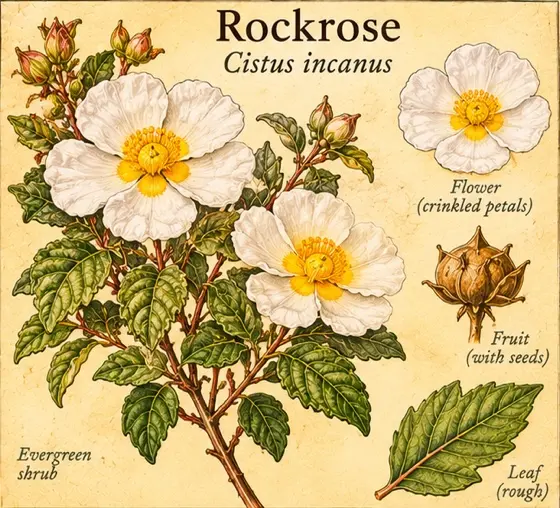
Rockrose
Cistus × incanus
A pink-flowered Mediterranean shrub whose polyphenol-rich leaves are used as a tea. In one trial, a rockrose extract eased cold symptoms more than placebo.
Safety at a glance
- PregnancyNothing recorded
- BreastfeedingNothing recorded
- MedicinesNothing recorded
- Who should avoid itNothing recorded
- AllergiesNothing recorded
- ToxicityNothing recorded
Tap a box to read the safety notes below. “Nothing recorded” means our sources don't cover it, not that it's safe.
What is Rockrose?
- Plant family
- Cistaceae, the rockrose family
- Parts used
- The leaves and flowering shoots
- Where it grows
- The Mediterranean region
- Genus
- Cistus
- Species
- × incanus
Also called
Cistus, Pink Rockrose, Hoary Rockrose
Older scientific names
Cistus incanus, Cistus creticus
Traditionally used for
- Colds and throat infections (studied)
- Gum inflammation (studied in a mixture)
- Fever and stomach complaints (traditional)
Traditionally described as
- Leaves rich in polyphenols
Health topics
Where Rockrose appears in symptom search, and why. Being listed doesn't mean it's a proven treatment.
- Colds and Nasal Congestion
In one trial, a rockrose extract eased cold symptoms more than placebo.
- Sore Throat
Traditionally used for throat and chest infections.
Traditions that use it
- Mediterranean Folk Medicine
Cistus leaf teas, extracts and essential oils have long been used for inflammation, chest infections, fevers and stomach complaints.
Natural compounds
How it's prepared
Common ways Rockrose is prepared or sold. This isn't advice on how to take it; see Safety below.
- Extract
A polyphenol-rich extract was tested in a cold trial.[1]Study
- Tea / Infusion
The leaves are drunk as a herbal tea.[2]Study
Safety
Side effects
Reviews describe rockrose as generally well tolerated, and it's sold as a herbal tea and supplement. However, there are few clinical studies, so little is known about its safety in pregnancy, while breastfeeding or alongside medicines.[2]Study
What does the research say?
Traditional use
These are traditional uses, not proven treatments.
Rockrose (Cistus) is a sun-loving shrub of the Mediterranean with pink, papery flowers. For centuries, its leaf teas, extracts and essential oils have been used for inflammation, chest and throat infections, fevers and stomach complaints.[2]Study
Laboratory & animal research
Lab and animal results show what might be worth studying in people. They don't show that the herb has these effects in humans.
Rockrose is rich in polyphenols, plant compounds that act as antioxidants. In lab studies, extracts have been studied for effects on cell damage, inflammation, aging and cancer.[2]Study
Research in people
In a trial of 160 people with a cold or other upper airway infection, symptoms eased more with a rockrose extract than with a placebo. A blood marker of inflammation (C-reactive protein) also fell in the rockrose group. Earlier lab and mouse studies found the extract acted against viruses and bacteria. Clinical studies of rockrose are still scarce.[1]Study
Technical detail: CYSTUS052 extract, rich in highly polymeric polyphenols; prospective, randomized, placebo-controlled.
In a 3-month trial, 60 adults with gingivitis (inflamed, bleeding gums) chewed 2 gums a day containing rockrose and American skullcap, or placebo gums. Gum bleeding, gum inflammation, pain and oral health scores improved with the herbal gum but not with the placebo. The gum was well tolerated. The effect of rockrose alone wasn't tested.[3]Study
Technical detail: Quantitative Gingival Bleeding Index, Modified Gingival Index, OH-15, VAS and CGI-S all decreased at 3 months; ISRCTN-registered.
In short
Few clinical studies; little is known about its safety in pregnancy or with medicines.
Sources
- [1] Cistus incanus (CYSTUS052) for treating patients with infection of the upper respiratory tract. A prospective, randomised, placebo-controlled clinical study · DOI: 10.1016/j.antiviral.2009.10.001Peer-reviewed study
- [2] Biology, Antioxidant Activity, and Therapeutic Potential of Cistus sp.—A Comprehensive Review · DOI: 10.3390/ijms26136400Peer-reviewed study
- [3] Efficacy and Tolerability of a Scutellaria lateriflora L. and Cistus × incanus L.-Based Chewing Gum on the Symptoms of Gingivitis: A Monocentric, Randomized, Double-Blind, Placebo-Controlled Clinical Trial · DOI: 10.3390/nu16060862Peer-reviewed study
This information is educational and traditional in nature, and is not a substitute for professional medical advice. Unfamiliar word? See what these words mean.