
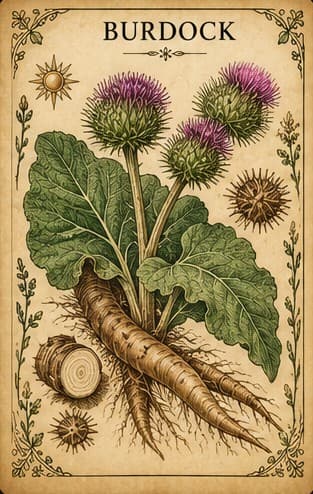
Burdock
Arctium lappa
A plant whose root has been eaten as food in Asia for centuries. It is traditionally used as a "blood purifier" and for skin problems, but there is little evidence in people.
Safety at a glance
- Pregnancy1 note →
- Breastfeeding1 note →
- MedicinesNothing recorded
- Who should avoid it1 note →
- Allergies2 notes →
- Toxicity1 note →
Tap a box to read the safety notes below. “Nothing recorded” means our sources don't cover it, not that it's safe.
What is Burdock?
- Plant family
- Asteraceae, the daisy family
- Parts used
- The root; the fruit is used in traditional Chinese medicine
- Where it grows
- Native to Europe and northern Asia; now found worldwide
- Genus
- Arctium
- Species
- lappa
Also called
Burdock Root, Lappa, Wild Gobo, Happy Major
Traditional names
Niubang
Older scientific names
Arctium majus
Traditionally used for
- Skin problems
- Appetite
- Urinary complaints
- Blood purifier (traditional)
- Skin brightening (seed oil lotion
- studied)
Traditionally described as
- Traditionally used as a blood purifier
Health topics
Where Burdock appears in symptom search, and why. Being listed doesn't mean it's a proven treatment.
- Acne
Burdock fruit is used on the skin for acne in traditional Chinese medicine. In lab tests, peptides from the root stopped the growth of acne bacteria. Not tested in people.
- Eczema
Used on the skin for eczema in traditional Chinese medicine. Not tested for eczema in trials.
- Liver Safety Warnings
One case of sudden liver injury was reported after an herbal tea containing burdock. It protected the liver in rats, but hasn't been studied for this in people.
- Loss of Appetite
Recognized in Europe as a traditional medicine for short-term loss of appetite.
- Skin Irritation, Rashes and Itching
Recognized in Europe as a traditional medicine for oily, flaky skin; traditionally used on the skin in Chinese medicine.
Traditions that use it
- Traditional Chinese Medicine
The fruit is valued as a blood purifier, for sore throat and colds, and on the skin for acne, eczema and psoriasis.
- European Folk Medicine
Recognized in Europe as a traditional herbal medicine for loss of appetite, minor urinary complaints and oily, flaky skin.
How it's prepared
Common ways Burdock is prepared or sold. This isn't advice on how to take it; see Safety below.
- Extract
Liquid and soft extracts of the root are taken by mouth.[1]Health agency
- Poultice
Herbalists apply it externally as a poultice for skin conditions.[2]General reference
- Powder
The powdered root is taken by mouth in tablets or capsules.[1]Health agency
- Tea / Infusion
The dried, cut root is made into an herbal tea.[1]Health agency
- Tincture
Tinctures (alcohol extracts) of the root are taken by mouth.[1]Health agency
Safety
Who should avoid it
Burdock medicines aren't recommended for anyone under 18. Don't take them with prescription water pills. See a doctor if you get fever, painful urination, cramps or blood in the urine.[1]Health agency
Allergies
Burdock can cause skin allergies. A 53-year-old man had a severe whole-body allergic reaction (anaphylaxis), with redness and trouble breathing, an hour after eating boiled burdock; he recovered with treatment. People allergic to chrysanthemums may also react to burdock.[3]General reference
Severe allergic reactions (anaphylactic shock) have been reported. Don't use burdock medicines if you're allergic to burdock or other daisy-family plants.[1]Health agency
Pregnancy
Avoid burdock during pregnancy: it may stimulate the uterus and increase the risk of premature birth.[3]General reference
Breastfeeding
Because there isn't enough safety data, burdock medicines aren't recommended during pregnancy or breastfeeding.[1]Health agency
Toxicity testing
A 36-year-old woman developed sudden liver injury after drinking an herbal tea sold for the liver that contained burdock. Her symptoms eased after she stopped the tea.[3]General reference
Contamination
Some burdock teas have been contaminated with atropine from the belladonna plant, which can affect the nervous system.[3]General reference
What does the research say?
Traditional use
These are traditional uses, not proven treatments.
In traditional Chinese medicine, burdock fruit is valued as a blood purifier and for sore throat and colds. It is also used on the skin for acne, eczema and psoriasis, and for poor appetite (anorexia) and gout. It is used for cancer and AIDS too, though there's no evidence it works for these. The root has been eaten as food in Asia for centuries.[3]General reference
Based on long-standing use, the European Medicines Agency recognizes burdock root as a traditional herbal medicine for:
- Increasing urine to flush the urinary tract in minor urinary complaints
- Short-term loss of appetite
- Oily, flaky skin conditions (seborrheic skin)
Laboratory & animal research
Lab and animal results show what might be worth studying in people. They don't show that the herb has these effects in humans.
In lab and animal studies, burdock showed effects against inflammation, bacteria, stomach ulcers, high blood sugar and cancer. In rats it protected the liver, possibly through its antioxidant activity. In animals, the root extract also stimulated the uterus.[3]General reference
Burdock seeds are rich in arctiin and arctigenin, plant compounds called lignans. In lab-grown human skin, an oil made from burdock seeds and enriched in arctigenin reduced melanin, the pigment that darkens skin, more than plain burdock seed oil. A lotion with this oil didn't irritate lab-grown skin.[4]Study
Technical detail: MelanoDerm and EpiDerm 3D tissue models; the enriched oil (ABSO) had about 5 times more arctigenin than burdock seed oil.
In lab tests, small proteins (peptides) taken from burdock root stopped the growth of bacteria linked to acne, and didn't harm skin cells at the amounts tested. Researchers made them into an experimental skin dressing. This hasn't been tested on people's skin.[5]Study
Technical detail: low-molecular-weight peptide fraction (<5,000 Da) active against Gram-positive Propionibacterium (Cutibacterium) acnes strains; fibroblast CC50 10 mg/mL; selectivity index 160–320; chitosan/alginate/genipin dressing.
Research in people
Research in people is limited to small studies:
- A cream with burdock extract improved the look of wrinkled skin.
- Burdock tea improved signs of inflammation in people with knee arthritis.
- Formulas containing burdock improved blood fats and after-meal blood sugar in people with kidney disease caused by diabetes.
There is no evidence that burdock treats cancer, infections, diabetes or other conditions. Larger studies are needed.[3]General reference
In an 8-week trial, 45 adults of Asian descent with uneven skin tone used a 1% lotion of arctigenin-enriched burdock seed oil or the same lotion without it, twice a day. Skin brightness and evenness improved compared with the start, and at week 4 brightness was better than with the plain lotion. Both lotions were well tolerated. The study was paid for and run by the two companies developing the ingredient, and all authors work for them and own stock in them.[4]Study
Technical detail: double-blind, vehicle-controlled; visual brightness +22.7% at week 4 vs vehicle (p = 0.0243); other gains were reported against baseline; Rohto Pharmaceutical and Signum Biosciences.
In short
Avoid during pregnancy; can cause severe allergic reactions, and one case of liver injury has been reported.
Sources
- [1] Community herbal monograph on Arctium lappa L., radix (EMA/HMPC/246763/2009) — European Medicines Agency, Committee on Herbal Medicinal Products (HMPC)Government health agency
- [2] Burdock — Herban Herbalist materia medica — Herban Herbalist (herb shop)General reference
- [3] Burdock — Memorial Sloan Kettering Cancer Center, About HerbsGeneral reference
- [4] Arctigenin-Enriched Burdock Seed Oil (ABSO): A New Skin Brightening Botanical Extract — Cosmetics · DOI: 10.3390/cosmetics10010010Peer-reviewed study
- [5] Anti-Acne Action of Peptides Isolated from Burdock Root-Preliminary Studies and Pilot Testing — Molecules · DOI: 10.3390/molecules25092027Peer-reviewed study
This information is educational and traditional in nature, and is not a substitute for professional medical advice. Unfamiliar word? See what these words mean.