
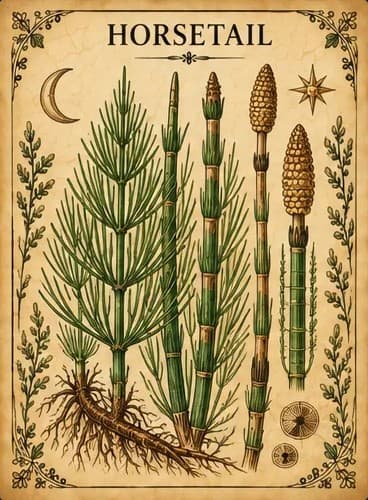
Horsetail
Equisetum arvense
A plant recognized in Europe as a traditional medicine for minor urinary complaints and, as a wash or dressing, for superficial wounds. One small trial found a horsetail ointment helped episiotomy wounds heal.
Safety at a glance
- Pregnancy1 note →
- Breastfeeding1 note →
- MedicinesNothing recorded
- Who should avoid it1 note →
- AllergiesNothing recorded
- ToxicityNothing recorded
Tap a box to read the safety notes below. “Nothing recorded” means our sources don't cover it, not that it's safe.
What is Horsetail?
- Plant family
- Equisetaceae, the horsetail family
- Parts used
- The green above-ground parts (herb)
- Genus
- Equisetum
- Species
- arvense
Also called
Field Horsetail, Horse Tail
Traditionally used for
- Superficial wounds
- Urinary complaints
Traditionally described as
- May increase urination
Health topics
Where Horsetail appears in symptom search, and why. Being listed doesn't mean it's a proven treatment.
- Cuts, Wounds, Burns and Skin Ulcers
Recognized in Europe as a traditional medicine for superficial wounds. One trial found a horsetail ointment helped episiotomy wounds heal.
Traditions that use it
- European Folk Medicine
Recognized in Europe as a traditional herbal medicine for minor urinary complaints and, used on the skin, for superficial wounds.
How it's prepared
Common ways Horsetail is prepared or sold. This isn't advice on how to take it; see Safety below.
- Decoction
The dried plant is simmered in water to make a liquid that's applied to the skin.[1]Health agency
- Extract
Dry and liquid extracts, and juice pressed from the fresh plant, are taken by mouth.[1]Health agency
- Tea / Infusion
The dried above-ground parts are made into an herbal tea, or taken in tablets or capsules.[1]Health agency
Safety
Who should avoid it
Don't take horsetail for urinary complaints if you've been told to limit how much you drink, for example because of serious heart or kidney disease. See a doctor if you get fever, painful urination, cramps or blood in the urine.[1]Health agency
Side effects
Allergic reactions, such as a rash or swelling of the face, have been reported. Taken by mouth, it may cause mild stomach and gut complaints. How often these happen isn't known.[1]Health agency
Pregnancy
There isn't enough safety data, so horsetail isn't recommended during pregnancy.[1]Health agency
Breastfeeding
Horsetail taken by mouth isn't recommended while breastfeeding, and horsetail products shouldn't be put on the breasts of breastfeeding women.[1]Health agency
How much to use
Horsetail medicines aren't recommended for children under 12. On wounds, see a doctor if the skin looks infected, symptoms get worse, or they last longer than 1 week.[1]Health agency
What does the research say?
Traditional use
These are traditional uses, not proven treatments.
Based on long-standing use, the European Medicines Agency recognizes horsetail as a traditional herbal medicine for:
- Increasing urine to flush the urinary tract in minor urinary complaints (as a tea or by mouth)
- Supporting the treatment of superficial wounds (as a boiled wash or soaked dressing)
It is for adults and teens over 12.[1]Health agency
Research in people
A small study in healthy men suggested horsetail has a mild effect on increasing urine. The European Medicines Agency found no clinical studies of horsetail for wounds.[2]Health agency
In a trial of 108 first-time mothers, a 3% horsetail ointment or a placebo was applied to their episiotomy wound (a cut made during childbirth) for 10 days. Wound healing and pain scores were significantly better in the horsetail group at 5 and 10 days.[3]Study
Technical detail: double-blind, randomized, placebo-controlled; REEDA wound-healing scale and visual analog pain scale; Tabriz, Iran.
In short
Don't use it for urinary complaints if you've been told to limit fluids, for example with serious heart or kidney disease.
Sources
- [1] European Union herbal monograph on Equisetum arvense L., herba (EMA/HMPC/278091/2015) — European Medicines Agency, Committee on Herbal Medicinal Products (HMPC)Government health agency
- [2] Horsetail herb (Equisetum arvense L., herba): summary of the HMPC conclusions (EMA/147173/2016) — European Medicines Agency, Committee on Herbal Medicinal Products (HMPC)Government health agency
- [3] The effect of Equisetum arvense (horse tail) ointment on wound healing and pain intensity after episiotomy: a randomized placebo-controlled trial — Iranian Red Crescent Medical Journal · DOI: 10.5812/ircmj.25637Peer-reviewed study
This information is educational and traditional in nature, and is not a substitute for professional medical advice. Unfamiliar word? See what these words mean.