
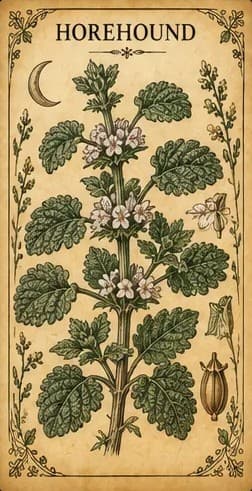
Horehound
Marrubium vulgare
White horehound, a bitter mint-family herb recognized in Europe as a traditional medicine to help bring up phlegm with a cold, and for indigestion and poor appetite.
Safety at a glance
- Pregnancy1 note →
- BreastfeedingNothing recorded
- MedicinesNothing recorded
- Who should avoid it1 note →
- AllergiesNothing recorded
- ToxicityNothing recorded
Tap a box to read the safety notes below. “Nothing recorded” means our sources don't cover it, not that it's safe.
What is Horehound?
- Plant family
- Lamiaceae, the mint family
- Parts used
- The above-ground parts (herb)
- Genus
- Marrubium
- Species
- vulgare
Also called
White Horehound, Marrubium
Traditionally used for
- Cough
- Chest congestion
- Indigestion
- Appetite
Traditionally described as
- May help loosen mucus
- Bitter
Health topics
Where Horehound appears in symptom search, and why. Being listed doesn't mean it's a proven treatment.
- Chest Congestion and Bronchitis
Recognized in Europe to help bring up phlegm.
- Cough
Recognized in Europe as a traditional medicine to help bring up phlegm with a cough from a cold.
- Indigestion
Recognized in Europe for mild indigestion such as bloating and gas.
- Loss of Appetite
Recognized in Europe as a traditional medicine for temporary loss of appetite.
Traditions that use it
- European Folk Medicine
Recognized in Europe as a traditional herbal medicine for cough with a cold, indigestion and poor appetite.
How it's prepared
Common ways Horehound is prepared or sold. This isn't advice on how to take it; see Safety below.
- Extract
Liquid extracts, and juice pressed from the fresh plant, are taken by mouth.[1]Health agency
- Powder
The powdered plant is taken by mouth in tablets or capsules.[1]Health agency
- Tea / Infusion
The dried flowering plant is made into an herbal tea.[1]Health agency
Safety
Who should avoid it
Don't use horehound if you have liver disease, a blocked or inflamed bile duct, a bowel blockage, or an allergy to mint-family plants. Ask a doctor first if you have a stomach ulcer, gallstones or other bile problems.[1]Health agency
Side effects
No side effects have been reported.[2]Health agency
Pregnancy
Its safety during pregnancy and breastfeeding hasn't been established, so it isn't recommended at these times.[1]Health agency
How much to use
Not recommended for children under 12. See a healthcare practitioner if a cough lasts more than a week, or indigestion or poor appetite lasts more than 2 weeks.[2]Health agency
What does the research say?
Traditional use
These are traditional uses, not proven treatments.
Based on long-standing use, the European Medicines Agency recognizes white horehound as a traditional herbal medicine for adults and teens over 12:
- To help bring up phlegm with a cough from a cold
- For mild indigestion, such as bloating and gas
- For short-term loss of appetite
Laboratory & animal research
Lab and animal results show what might be worth studying in people. They don't show that the herb has these effects in humans.
Its bitter compounds and essential oils may stimulate appetite and the secretions lining the airways. Lab studies suggest several effects that could plausibly help mild indigestion.[2]Health agency
Research in people
Horehound is used in Mexican folk medicine for diabetes. In a 2004 Mexican trial, 21 people with poorly controlled type 2 diabetes drank horehound leaf tea for 3 weeks alongside their usual treatment. It barely changed blood sugar (down 0.6%) or blood fats, while another plant tested in the same trial lowered them more.[3]Study
In short
Don't use it with liver disease, a blocked bile duct or a bowel blockage; ask a doctor first if you have gallstones or an ulcer.
Sources
- [1] Community herbal monograph on Marrubium vulgare L., herba (EMA/HMPC/604271/2012) — European Medicines Agency, Committee on Herbal Medicinal Products (HMPC)Government health agency
- [2] White horehound (Marrubium vulgare L., herba): summary of the HMPC conclusions (EMA/HMPC/446032/2013) — European Medicines Agency, Committee on Herbal Medicinal Products (HMPC)Government health agency
- [3] Clinical trial of Cecropia obtusifolia and Marrubium vulgare leaf extracts on blood glucose and serum lipids in type 2 diabetics · DOI: 10.1016/j.phymed.2004.01.006Peer-reviewed study
This information is educational and traditional in nature, and is not a substitute for professional medical advice. Unfamiliar word? See what these words mean.