
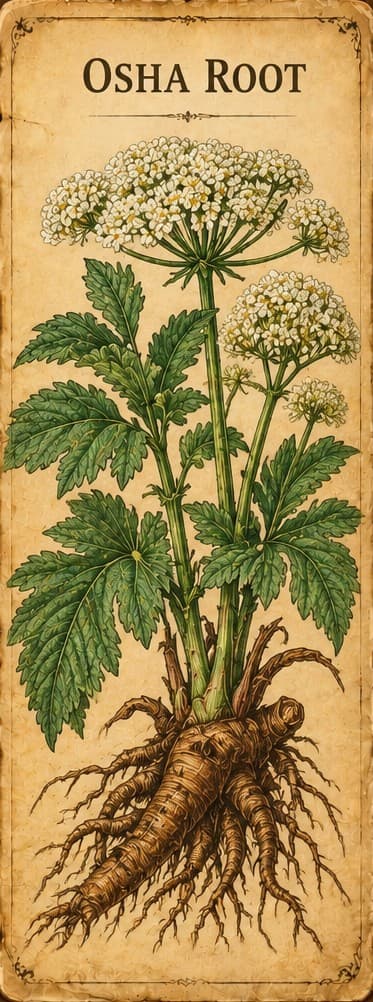
Osha
Ligusticum porteri
A root from the Rocky Mountains, long used by Hispanic and Native American peoples for colds, flu and chest infections. It has only been studied in the lab.
Safety at a glance
- PregnancyNothing recorded
- BreastfeedingNothing recorded
- MedicinesNothing recorded
- Who should avoid itNothing recorded
- AllergiesNothing recorded
- ToxicityNothing recorded
Tap a box to read the safety notes below. “Nothing recorded” means our sources don't cover it, not that it's safe.
What is Osha?
- Plant family
- Apiaceae, the carrot and parsley family
- Parts used
- The root
- Where it grows
- Found in parts of the Rocky Mountains
- Genus
- Ligusticum
- Species
- porteri
Also called
Osha Root
Traditionally used for
- Colds
- Flu
- Chest infections
- Indigestion
Traditionally described as
- Traditionally used for colds and flu
Health topics
Where Osha appears in symptom search, and why. Being listed doesn't mean it's a proven treatment.
- Chest Congestion and Bronchitis
Traditionally used for chest infections. It hasn't been studied in people; chest infections with shortness of breath need medical care.
- Colds and Nasal Congestion
Traditionally used for colds and flu. It hasn't been studied in people.
Traditions that use it
- Native American Ethnobotany
Used for many years by Hispanic and Native American peoples for colds, flu, chest infections and digestive upset.
How it's prepared
Common ways Osha is prepared or sold. This isn't advice on how to take it; see Safety below.
- Decoction
It's widely taken as a decoction.[1]Study
- Tea / Infusion
A tea is made from the roots.[1]Study
What does the research say?
Traditional use
These are traditional uses, not proven treatments.
Osha root is used to boost the immune system and for colds, flu, indigestion and body aches.[2]Study
Hispanic and Native American peoples have used osha for many years. It has been used for flu, chest infections (bronchial pneumonia) with shortness of breath, poor appetite, indigestion and upset stomach with vomiting.[3]Study
Laboratory & animal research
Lab and animal results show what might be worth studying in people. They don't show that the herb has these effects in humans.
In lab tests on human leukemia cells, osha root extract showed antioxidant activity and affected immune signals, but didn't stop the cancer cells growing.[3]Study
In short
No studies in people have tested its safety or effects.
Sources
- [1] Mexican Plants and Derivates Compounds as Alternative for Inflammatory and Neuropathic Pain Treatment-A Review · DOI: 10.3390/plants10050865Peer-reviewed study
- [2] Analysis of Southwestern Colorado Ligusticum porteri by Gas Chromatography-Mass Spectrometry — Journal of Undergraduate Chemistry ResearchPeer-reviewed study
- [3] Effects of Ligusticum porteri (Osha) Root Extract on Human Promyelocytic Leukemia Cells — Pharmacognosy Research · DOI: 10.4103/0974-8490.204641Peer-reviewed study
This information is educational and traditional in nature, and is not a substitute for professional medical advice. Unfamiliar word? See what these words mean.