
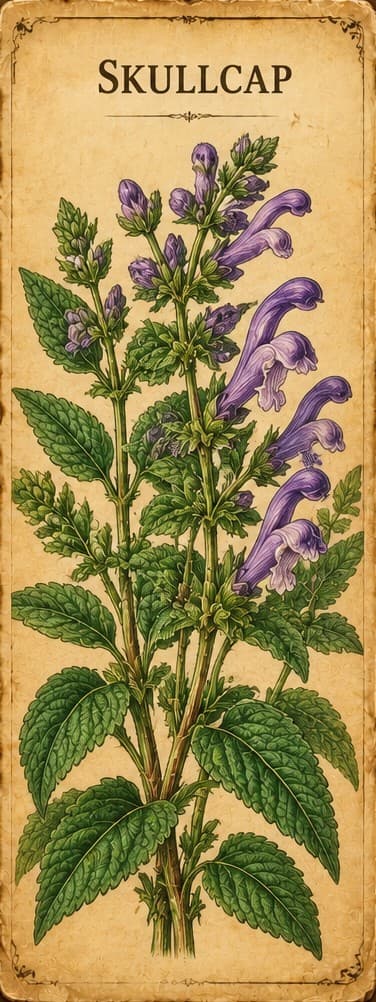
Skullcap
Scutellaria lateriflora
A North American mint-family herb, taken as a tea or extract for anxiety, stress and sleep. It has been linked to rare cases of liver injury, often in mixed products.
Safety at a glance
- PregnancyNothing recorded
- BreastfeedingNothing recorded
- MedicinesNothing recorded
- Who should avoid itNothing recorded
- AllergiesNothing recorded
- Toxicity1 note →
Tap a box to read the safety notes below. “Nothing recorded” means our sources don't cover it, not that it's safe.
What is Skullcap?
- Plant family
- Lamiaceae, the mint family
- Parts used
- The dried leaves and stems, as a tea or extract. The Cherokee used the root.
- Where it grows
- North America
- Genus
- Scutellaria
- Species
- lateriflora
Also called
American Skullcap, Blue Skullcap, Scullcap
Traditionally used for
- Anxiety
- Stress
- Sleep
- Period problems (traditional)
Traditionally described as
- May lift mood (one small study)
Health topics
Where Skullcap appears in symptom search, and why. Being listed doesn't mean it's a proven treatment.
- Anxiety
Traditionally used for anxiety. In one small study of healthy adults it improved overall mood, but anxiety scores weren't clearly better than a dummy pill.
- Sleep Problems (Insomnia)
Traditionally taken as a tea or extract for trouble sleeping.
- Stress
Traditionally taken as a tea or extract for stress.
Traditions that use it
- Native American Ethnobotany
Used for centuries by Native Americans, including the Cherokee, for period problems, nerves, digestion and kidney problems.
- Western Herbalism
Used today as a tea or extract for anxiety, stress and sleep problems.
How it's prepared
Common ways Skullcap is prepared or sold. This isn't advice on how to take it; see Safety below.
- Extract
The dried leaves and stems are also taken as an extract.[1]Health agency
- Tea / Infusion
The dried leaves and stems are taken as a tea.[1]Health agency
- Tincture
Herbalists use it as a tincture.[2]General reference
Safety
Toxicity testing
Skullcap has been linked to rare cases of liver injury. In most cases people were taking several herbs at once, so skullcap's role was unclear.
Some products sold as skullcap were found to be mislabeled or mixed with germander, an herb that damages the liver.[1]Health agency
What does the research say?
Traditional use
These are traditional uses, not proven treatments.
Native Americans have used skullcap for centuries for period problems, nervousness, and digestive and kidney problems. Today its dried leaves and stems are taken as a tea or extract for anxiety, stress and trouble sleeping.[1]Health agency
The Cherokee used skullcap root:
- As a tea for periods and diarrhea
- Boiled, to help expel the afterbirth after childbirth
- For breast pain and for "nerves"
Research in people
In one study, 43 healthy adults took freeze-dried skullcap (350 mg, 3 times a day) and a dummy pill for 2 weeks each, in random order. Anxiety scores were not clearly different between skullcap and the dummy pill.
Overall mood improved while people took skullcap but not while they took the dummy pill. Most people weren't anxious to begin with, which limits the findings. Skullcap didn't reduce energy or thinking ability.[4]Study
Technical detail: double-blind, placebo-controlled crossover; Beck Anxiety Inventory p = 0.191; Profile of Mood States total mood disturbance fell from baseline with skullcap (p < 0.001) but not placebo (p = 0.072); carryover effect noted.
In short
Rare liver injury has been reported; some products were mixed with germander, which harms the liver.
Sources
- [1] LiverTox: Skullcap — National Institute of Diabetes and Digestive and Kidney Diseases (NIH)Government health agency
- [2] Skullcap — Herban Herbalist materia medica — Herban Herbalist (herb shop)General reference
- [3] The Phytochemistry of Cherokee Aromatic Medicinal Plants · DOI: 10.3390/medicines5040121Peer-reviewed study
- [4] American Skullcap (Scutellaria lateriflora): a randomised, double-blind placebo-controlled crossover study of its effects on mood in healthy volunteers · DOI: 10.1002/ptr.5044Peer-reviewed study
This information is educational and traditional in nature, and is not a substitute for professional medical advice. Unfamiliar word? See what these words mean.