
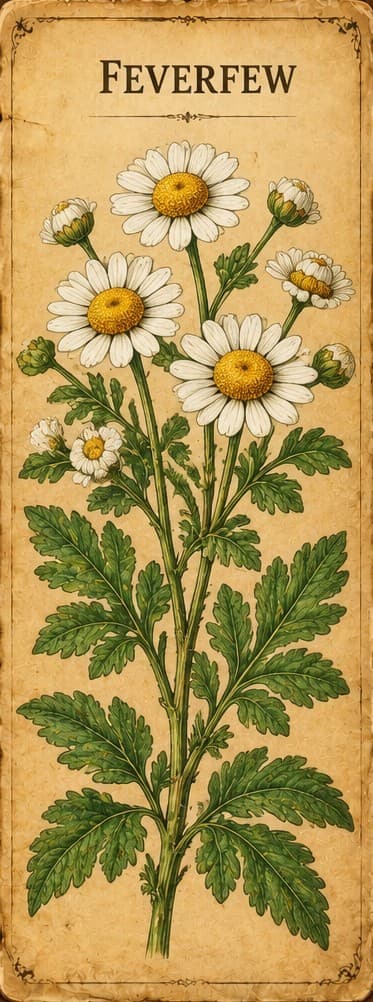
Feverfew
Tanacetum parthenium
A daisy-like herb recognised in Europe as a traditional remedy to help prevent migraines. Research results are mixed. Don't take it during pregnancy.
Safety at a glance
- Pregnancy1 note →
- BreastfeedingNothing recorded
- MedicinesNothing recorded
- Who should avoid itNothing recorded
- Allergies2 notes →
- ToxicityNothing recorded
Tap a box to read the safety notes below. “Nothing recorded” means our sources don't cover it, not that it's safe.
What is Feverfew?
- Plant family
- Asteraceae, the daisy family
- Parts used
- The dried leaves and other above-ground parts, taken by mouth; some people chew the fresh leaves
- Genus
- Tanacetum
- Species
- parthenium
Also called
Bachelor's Buttons, Featherfew
Older scientific names
Chrysanthemum parthenium, Matricaria parthenium
Traditionally used for
- Migraine prevention
- Headache
- Fever (traditional)
Traditionally described as
- May reduce how often migraines happen (mixed evidence)
Health topics
Where Feverfew appears in symptom search, and why. Being listed doesn't mean it's a proven treatment.
- Headache
Recognised in Europe as a traditional remedy to help prevent migraines. Research results are mixed: some studies found fewer migraines, others didn't.
Traditions that use it
- European Folk Medicine
Recognised in Europe as a traditional remedy to help prevent migraines.
- Western Herbalism
Historically used for fevers, headaches, period problems and many other complaints.
How it's prepared
Common ways Feverfew is prepared or sold. This isn't advice on how to take it; see Safety below.
- Powder
The powdered dried plant is taken by mouth in tablets or capsules.[1]Health agency
- Tea / Infusion
Herbalists steep 1 to 2 teaspoons of the herb in a cup of boiling water.[2]General reference
- Tincture
Herbalists use it as a tincture.[2]General reference
Safety
Allergies
Don't use feverfew if you're allergic to it or to other plants in the daisy family (Asteraceae).[3]Health agency
People who are sensitive to ragweed may have an allergic reaction to feverfew.[4]Health agency
Side effects
No serious side effects have been reported. It can cause nausea, digestive problems and bloating, and chewing the fresh leaves can irritate the mouth.[4]Health agency
Pregnancy
Don't take feverfew while pregnant, because it may affect contractions of the womb.[4]Health agency
Before surgery
Feverfew may slow blood clotting. Stop taking it at least 2 weeks before a planned surgery.[4]Health agency
How much to use
For adults only. See a doctor if migraines come back after 2 months of use, or if they get worse while you're taking it.[3]Health agency
What does the research say?
Traditional use
These are traditional uses, not proven treatments.
Historically, people used feverfew for many complaints, including:
- Fever
- Breathing and digestive problems
- Period problems and infertility
- Kidney and liver disease
- Ringing in the ears and earache
- Anemia
The European Medicines Agency recognises feverfew as a traditional herbal medicine to help prevent migraines in adults, once a doctor has ruled out serious conditions. This is based on at least 30 years of use, not on clinical trials, which weren't strong enough to draw firm conclusions. It usually needs to be taken for 2 months to have an effect.[3]Health agency
Research in people
A 2020 review looked at 7 studies of feverfew for migraine, with 634 people in total. The results were inconsistent. Some studies suggest it may make migraines less frequent and ease pain, nausea, vomiting and sensitivity to light and noise, but overall the evidence is mixed.[4]Health agency
In short
Don't use during pregnancy or if you're allergic to daisy-family plants; stop 2 weeks before surgery.
Sources
- [1] European Union herbal monograph on Tanacetum parthenium (L.) Schultz Bip., herba — European Medicines Agency, Committee on Herbal Medicinal Products (HMPC)Government health agency
- [2] Feverfew — Herban Herbalist materia medica — Herban Herbalist (herb shop)General reference
- [3] Tanaceti parthenii herba (feverfew herb): herbal medicinal product summary — European Medicines Agency (EMA), Committee on Herbal Medicinal ProductsGovernment health agency
- [4] Feverfew: Usefulness and Safety — National Center for Complementary and Integrative Health (NIH)Government health agency
This information is educational and traditional in nature, and is not a substitute for professional medical advice. Unfamiliar word? See what these words mean.