
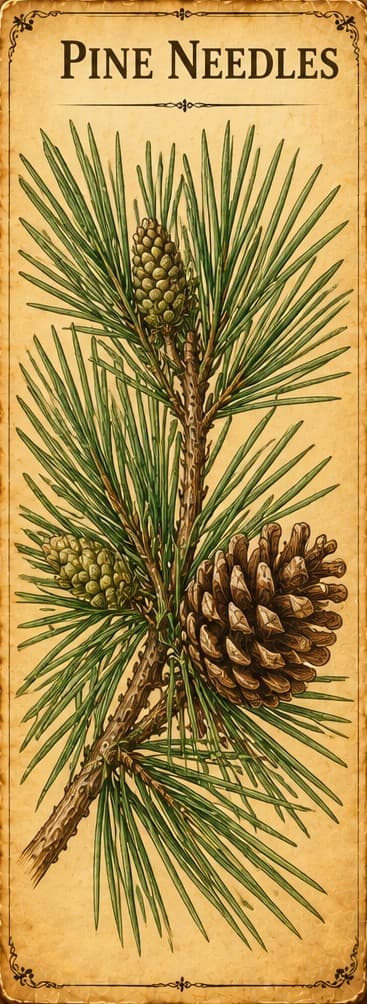
Pine Needles
Pinus spp.
Needles of pine trees, brewed into a tea popular in Japan, Korea, China and Russia, and used in folk medicine for coughs, colds and flu. Some pines contain a substance that causes miscarriage in cattle.
Safety at a glance
- Pregnancy1 note →
- BreastfeedingNothing recorded
- MedicinesNothing recorded
- Who should avoid itNothing recorded
- AllergiesNothing recorded
- ToxicityNothing recorded
Tap a box to read the safety notes below. “Nothing recorded” means our sources don't cover it, not that it's safe.
What is Pine Needles?
- Plant family
- Pinaceae, the pine family
- Parts used
- The needles, as a tea or hot decoction, and their essential oil; the bark, resin, cones and seeds are also used
- Genus
- Pinus
- Species
- spp.
Also called
Pine Needle Tea, Pine
Traditionally used for
- Coughs and colds (traditional)
- Flu (traditional)
- Skin infections and wounds (traditional)
- Tea
Traditionally described as
- Antioxidant (in lab tests)
- Kills bacteria and fungi (in lab tests)
Health topics
Where Pine Needles appears in symptom search, and why. Being listed doesn't mean it's a proven treatment.
- Cough
Pine needle decoctions are traditionally used for coughs. Not tested in trials.
- Immune Support (Colds and Flu)
Pine needle tea is traditionally used for colds and flu, and by the Algonquin to strengthen the immune system. Not tested in trials.
Traditions that use it
- Native American Ethnobotany
The Algonquin people have used white pine needle tea to strengthen the immune system.
How it's prepared
Common ways Pine Needles is prepared or sold. This isn't advice on how to take it; see Safety below.
- Tea / Infusion
Pine needle tea is very popular in Japan, Russia, Korea and China.[1]Study
Safety
Pregnancy
Ponderosa pine needles, fresh or dry, cause miscarriage in pregnant cattle, usually within 2 days to 2 weeks of eating them. The cause is a natural chemical called isocupressic acid, also found in lodgepole pine, common juniper and Monterey cypress. Effects in people haven't been studied.[2]Health agency
What does the research say?
Traditional use
These are traditional uses, not proven treatments.
Pine needle tea is very popular in Japan, Russia, Korea and China. Around the world, healers have used pine needles, bark, resin, cones and seeds for:
- Coughs, colds and flu
- Skin infections and wounds
- Inflammation
- Diabetes
The Algonquin people have used white pine needle tea to strengthen the immune system. In Latin America, especially Mexico, pine is important in folk medicine.[1]Study
Laboratory & animal research
Lab and animal results show what might be worth studying in people. They don't show that the herb has these effects in humans.
In lab tests, pine needle extracts and essential oils have shown antioxidant activity, killed some bacteria and fungi, and may help reduce inflammation. Scots pine needle extract slowed the growth of some breast cancer cells. The review found a large gap between traditional uses and scientific testing.[1]Study
In short
Ponderosa and lodgepole pine needles cause miscarriage in cattle; effects in people haven't been studied.
Sources
- [1] Ethnopharmacology of Pinus species with focus on the Hispaniola pine (Pinus occidentalis Swartz): evidence, gaps, and research roadmap · DOI: 10.3389/fphar.2025.1680390Peer-reviewed study
- [2] Ponderosa Pine (Pinus ponderosa) — USDA Agricultural Research Service, Poisonous Plant Research LaboratoryGovernment health agency
This information is educational and traditional in nature, and is not a substitute for professional medical advice. Unfamiliar word? See what these words mean.