
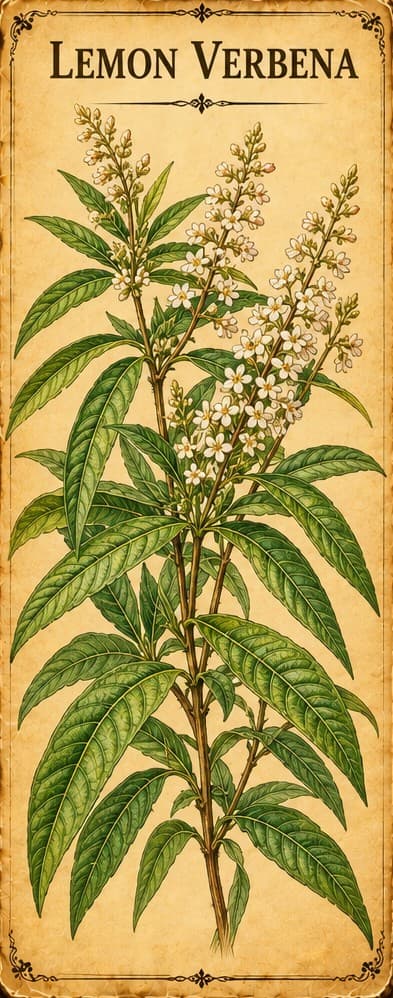
Lemon Verbena
Aloysia citrodora
A lemon-scented shrub whose leaves make a herbal tea. It's recognised in Europe as a traditional remedy for mild stress, to help sleep, and for mild digestive complaints such as bloating and gas.
Safety at a glance
- Pregnancy1 note →
- BreastfeedingNothing recorded
- MedicinesNothing recorded
- Who should avoid itNothing recorded
- Allergies1 note →
- ToxicityNothing recorded
Tap a box to read the safety notes below. “Nothing recorded” means our sources don't cover it, not that it's safe.
What is Lemon Verbena?
- Plant family
- Verbenaceae, the verbena family
- Parts used
- The dried leaves, as a herbal tea
- Genus
- Aloysia
- Species
- citrodora
Also called
Lemon Verbena Leaf
Regional names
Verveine Odorante
Older scientific names
Aloysia triphylla, Lippia citriodora
Traditionally used for
- Stress
- Sleep
- Bloating
- Gas
- Herbal tea
Traditionally described as
- May ease bloating and gas (traditional)
- May help you relax (traditional)
Health topics
Where Lemon Verbena appears in symptom search, and why. Being listed doesn't mean it's a proven treatment.
- Bloating
Recognised in Europe as a traditional remedy for mild bloating and gas. Based on long use, not trials.
- Sleep Problems (Insomnia)
Two trials found a lemon verbena extract improved sleep quality.
- Stress
In one trial, a lemon verbena extract lowered stress and cortisol.
Traditions that use it
- European Folk Medicine
Recognised in Europe as a traditional remedy for mild stress, sleep and mild digestive complaints.
How it's prepared
Common ways Lemon Verbena is prepared or sold. This isn't advice on how to take it; see Safety below.
- Tea / Infusion
The dried, cut leaves are made into an herbal tea.[1]Health agency
Safety
Allergies
Don't use it if you're allergic to lemon verbena or other plants in the verbena family (Verbenaceae).[1]Health agency
Side effects
Lemon verbena may make you drowsy. If it does, don't drive or use machinery. No other side effects are known.[1]Health agency
Pregnancy
Not recommended during pregnancy or breastfeeding, because its safety hasn't been established.[1]Health agency
How much to use
Not recommended for children. As a tea:
- For stress: 5 g of leaf boiled in 100 ml of water, 3 times a day
- For sleep: 1–2 g in 200 ml of boiling water, half an hour before bed
- For digestion: 2–3 g in 200 ml of boiling water, 1–3 times a day
See a doctor if symptoms last more than 2 weeks or get worse.[1]Health agency
What does the research say?
Traditional use
These are traditional uses, not proven treatments.
The European Medicines Agency recognises lemon verbena leaf tea as a traditional herbal medicine for teenagers and adults:
- To relieve mild symptoms of mental stress
- To help sleep
- For mild digestive complaints, including bloating and gas
This is based on long use alone, not on clinical trials.[1]Health agency
Research in people
In a 2024 Spanish trial, 71 healthy adults with sleep problems took a lemon verbena extract or a dummy pill for 3 months. The extract improved sleep quality, helped people fall asleep faster and sleep more efficiently, and raised night-time melatonin.[2]Study
In an 8-week trial, people taking a lemon verbena extract reported less stress, with lower levels of the stress hormone cortisol, and felt better rested, spending more time in deep and dream (REM) sleep, compared with a dummy pill.[3]Study
In a 2025 UK trial, 120 children aged 8 to 17 with mild ADHD-like behaviour took lemon verbena extract or a dummy for 8 weeks. Children taking it felt less energetic but thinking wasn't impaired, had fewer depression symptoms at the end, and parents reported a trend toward less hyperactivity.[4]Study
In short
May make you drowsy; not recommended for children or during pregnancy or breastfeeding.
Sources
- [1] European Union herbal monograph on Aloysia citrodora Paláu, folium (lemon verbena leaf) — European Medicines Agency (EMA), Committee on Herbal Medicinal ProductsGovernment health agency
- [2] Dietary Supplementation with an Extract of Aloysia citrodora (Lemon verbena) Improves Sleep Quality in Healthy Subjects: A Randomized Double-Blind Controlled Study · DOI: 10.3390/nu16101523Peer-reviewed study
- [3] Anxiolytic Effect and Improved Sleep Quality in Individuals Taking Lippia citriodora Extract · DOI: 10.3390/nu14010218Peer-reviewed study
- [4] Daily supplementation with lemon verbena extract decreases subjective energy and parental reports of hyperactivity in children displaying sub-clinical attention deficit hyperactivity disorder-type behaviours: A randomised controlled trial · DOI: 10.1177/02698811251324574Peer-reviewed study
This information is educational and traditional in nature, and is not a substitute for professional medical advice. Unfamiliar word? See what these words mean.