
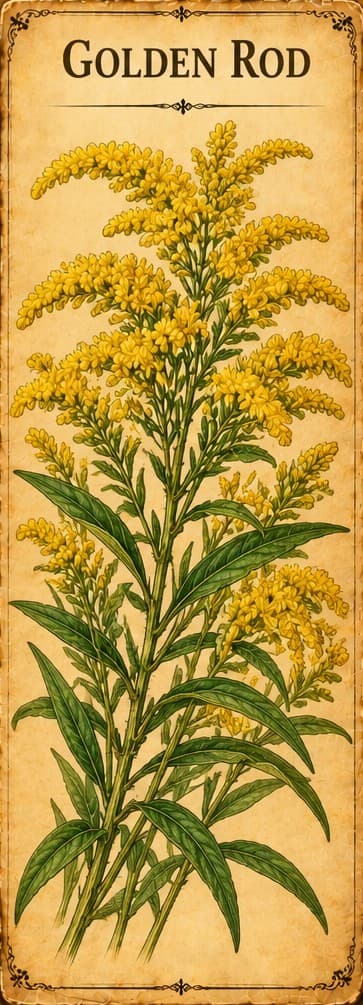
Goldenrod
Solidago virgaurea
European goldenrod, recognised in Europe as a traditional remedy to increase urine flow alongside treatment for minor urinary complaints.
Safety at a glance
- Pregnancy1 note →
- BreastfeedingNothing recorded
- MedicinesNothing recorded
- Who should avoid it1 note →
- Allergies1 note →
- Toxicity1 note →
Tap a box to read the safety notes below. “Nothing recorded” means our sources don't cover it, not that it's safe.
What is Goldenrod?
- Plant family
- Asteraceae, the daisy family
- Parts used
- The flowering above-ground parts, as a tea, tincture or extract
- Genus
- Solidago
- Species
- virgaurea
Also called
European Goldenrod, Golden Rod, Solidago
Traditionally used for
- Minor urinary complaints
- Increasing urine flow
Traditionally described as
- May increase urination (traditional)
Health topics
Where Goldenrod appears in symptom search, and why. Being listed doesn't mean it's a proven treatment.
- Bladder and Urinary Tract Infections (UTIs)
Recognised in Europe as a traditional remedy to increase urine flow alongside treatment for minor urinary complaints. Based on long use, not trials.
- Colds and Nasal Congestion
Used by herbalists for sinus congestion from allergies and colds. Not tested in trials.
- Cuts, Wounds, Burns and Skin Ulcers
A traditional Native American and European wound remedy. Not tested in trials.
Traditions that use it
- European Folk Medicine
Recognised in Europe as a traditional remedy to increase urine flow in minor urinary complaints.
How it's prepared
Common ways Goldenrod is prepared or sold. This isn't advice on how to take it; see Safety below.
- Extract
Preparations of the plant are sold as tablets, capsules or liquids to take by mouth.[1]Health agency
- Tea / Infusion
The dried flowering plant is made into an herbal tea.[1]Health agency
Safety
Who should avoid it
Don't use goldenrod if you're allergic to it or to other plants in the daisy family (Asteraceae), or if you've been told to drink less fluid because of severe heart or kidney disease. Don't take it with prescription water pills. Not recommended for children under 12.[1]Health agency
Allergies
Rarely, goldenrod has caused allergic skin rashes after handling or taking it. Goldenrod is often blamed for hay fever, but its pollen is carried by insects rather than the wind; the usual culprit is ragweed, which flowers at the same time.[2]General reference
Side effects
Allergic reactions and stomach or gut upset may occur.[1]Health agency
Pregnancy
Not recommended during pregnancy or breastfeeding, because there isn't enough data on its safety.[1]Health agency
Toxicity testing
Make sure it's really goldenrod (Solidago) before using it. Some yellow-flowered look-alikes in the daisy family, such as ragwort and groundsel (Senecio and related plants), contain pyrrolizidine alkaloids that can cause permanent liver damage, sometimes with no symptoms for months. Use a local field guide.[2]General reference
How much to use
See a doctor if you get a fever, pain or difficulty when urinating, cramps or blood in your urine, or if symptoms don't improve. Drink enough fluids when taking extracts.[1]Health agency
Technical detail: infusion 3–5 g, 2–4 times daily; liquid extract or tincture 0.5–2 ml, 3 times daily; dry extract 350–450 mg, 3 times daily.
What does the research say?
Traditional use
These are traditional uses, not proven treatments.
The European Medicines Agency recognises goldenrod as a traditional herbal medicine to increase the amount of urine, alongside treatment for minor urinary complaints, in adults and teenagers. This is based on long use alone. It's traditionally taken for 2 to 4 weeks.[1]Health agency
Most goldenrod species are native to North America. More than a dozen Native American groups have used close to twenty species, on the skin for sores, infections, burns and wounds and for toothache, and internally for urinary, breathing and digestive problems; some tribes use the root. The Kawaiisu use a leaf decoction of California goldenrod on boils and sores. In Europe, European goldenrod was a folk remedy to lessen bleeding and diarrhoea and to heal wounds, earning it the name woundwort; in 1640 the herbalist John Parkinson called it one of the best wound herbs. The name Solidago means "to make whole".[2]General reference
Herbalists today use goldenrod's leaves and flowers, as tea or tincture, for sinus congestion from allergies, colds and flu, for urinary tract infections (often with marshmallow root, corn silk and uva ursi), and for bloating and indigestion. As a gargle with sage it's used for sore throats. These uses come from herbal practice and haven't been tested in clinical trials.[2]General reference
In short
Don't use it with severe heart or kidney disease, or if you're allergic to daisy-family plants.
Sources
- [1] Community herbal monograph on Solidago virgaurea L., herba — European Medicines Agency (EMEA), Committee on Herbal Medicinal ProductsGovernment health agency
- [2] Goldenrod Benefits: The Bee's Knees for Allergies, Sinus Infections, and Urinary Tract Infections — Chestnut School of Herbal MedicineGeneral reference
This information is educational and traditional in nature, and is not a substitute for professional medical advice. Unfamiliar word? See what these words mean.