
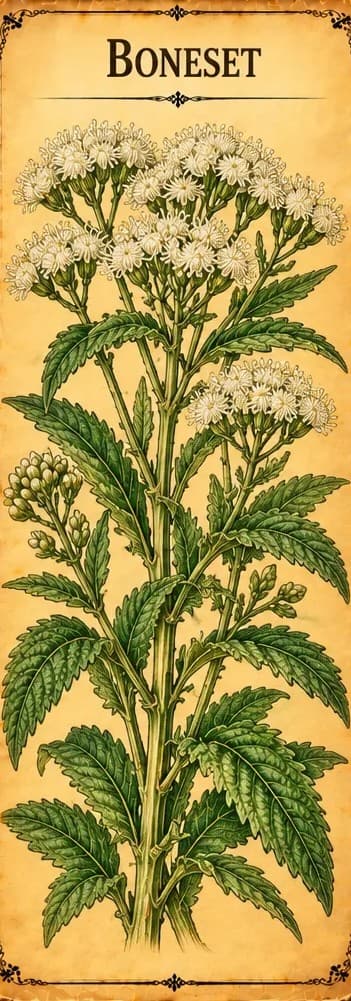
Boneset
Eupatorium perfoliatum
A North American wildflower long used as a tea for fever, flu, colds and coughs. In the lab, an extract stopped flu viruses from infecting cells, but it hasn't been tested in people.
Safety at a glance
- Pregnancy1 note →
- BreastfeedingNothing recorded
- MedicinesNothing recorded
- Who should avoid itNothing recorded
- AllergiesNothing recorded
- Toxicity1 note →
Tap a box to read the safety notes below. “Nothing recorded” means our sources don't cover it, not that it's safe.
What is Boneset?
- Plant family
- Asteraceae, the daisy family
- Parts used
- The leaves and other above-ground parts, as tea or as an alcohol-and-water extract
- Where it grows
- North America, including Kentucky, in wet meadows and along streams
- Genus
- Eupatorium
- Species
- perfoliatum
Also called
Thoroughwort, Eupatorium
Traditionally used for
- Fever and flu (traditional)
- Colds (traditional)
- Cough (traditional)
- Laxative (traditional)
Traditionally described as
- Blocked flu virus (in lab studies)
Health topics
Where Boneset appears in symptom search, and why. Being listed doesn't mean it's a proven treatment.
- Colds and Nasal Congestion
Used as a tea for colds and flu; an extract stopped flu viruses infecting cells in the lab. Not tested in people.
- Cough
Eastern Kentucky locals drink boneset leaf tea to calm coughs. Not tested in trials.
- Fever
A traditional Native American and folk remedy for fever and flu. Not tested in trials.
Traditions that use it
- Native American Ethnobotany
Used by Native Americans for fever and infections, and as a whole-plant tea for colds, sore throat and flu.
How it's prepared
Common ways Boneset is prepared or sold. This isn't advice on how to take it; see Safety below.
- Tea / Infusion
Native Americans drank it as a tonic tea, and in Eastern Kentucky people still drink boneset leaf tea.[1]Study
Safety
Pregnancy
Boneset contains pyrrolizidine alkaloids. In animal studies, these compounds passed into milk and harmed nursing young, and exposure before birth damaged the liver and lungs of unborn rats. The European Medicines Agency sets a strict daily limit for these compounds in herbal medicines, and says that limit also covers pregnant and breastfeeding women.[2]Health agency
Technical detail: maximum daily oral intake 1.0 µg of unsaturated PAs.
Toxicity testing
All 49 boneset samples tested in a 2018 study contained pyrrolizidine alkaloids, natural compounds linked to liver disease in people. Teas and tinctures made from the herb had high levels. The researchers advised caution until the risk is better understood.[3]Study
Technical detail: dehydropyrrolizidine alkaloids at 0.0002–0.07% w/w, mainly lycopsamine and intermedine and their N-oxides.
What does the research say?
Traditional use
These are traditional uses, not proven treatments.
Boneset has long been used for fever, flu and the bone pain that comes with fevers. Native Americans used it as a tonic tea for colds, sore throat and flu. In Eastern Kentucky, local people still drink boneset leaf tea as a laxative and to calm coughs. It has also been used to bring on sweating and for digestion.[1]Study
Native Americans used the above-ground parts for fever and infections. In Europe today, alcohol-and-water extracts are used in herbal medicine for infections of the nose and throat.[4]Study
Laboratory & animal research
Lab and animal results show what might be worth studying in people. They don't show that the herb has these effects in humans.
In a 2016 lab study, an extract of boneset stopped flu viruses from attaching to and infecting cells. This hasn't been tested in people.[4]Study
Other lab and animal studies report that boneset stimulates the immune system, may help reduce inflammation, protects the heart and kills bacteria. These haven't been confirmed in people.[1]Study
Sources
- [1] A Review and Survey of Local Eastern Kentucky Medicinal Plants and Their Pharmacological Benefits · DOI: 10.3390/plants14203182Peer-reviewed study
- [2] Public statement on the use of herbal medicinal products containing toxic, unsaturated pyrrolizidine alkaloids (PAs) (EMA/HMPC/893108/2011 Rev. 1) — European Medicines Agency, Committee on Herbal Medicinal Products (HMPC)Government health agency
- [3] Potentially toxic pyrrolizidine alkaloids in Eupatorium perfoliatum and three related species. Implications for herbal use as boneset · DOI: 10.1002/pca.2775Peer-reviewed study
- [4] Antiviral activity of hydroalcoholic extract from Eupatorium perfoliatum L. against the attachment of influenza A virus · DOI: 10.1016/j.jep.2016.05.016Peer-reviewed study
This information is educational and traditional in nature, and is not a substitute for professional medical advice. Unfamiliar word? See what these words mean.