
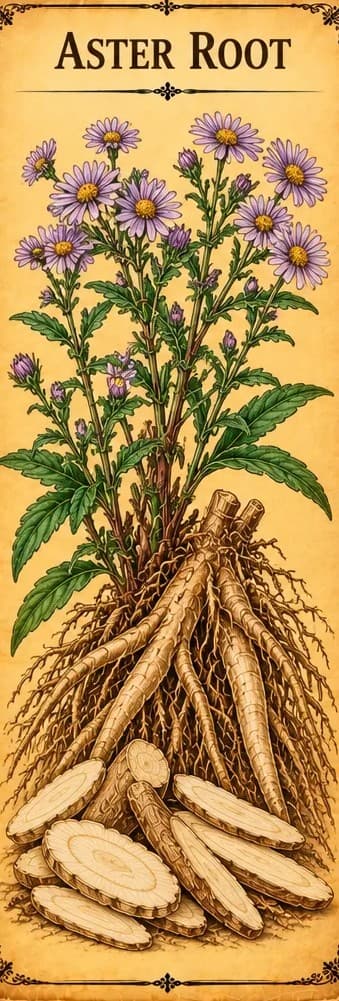
Aster Root
Aster tataricus
Zi wan, the soft purple root of Aster tataricus, a classic Chinese, Japanese and Korean remedy to moisten the lungs and relieve cough and phlegm.
Safety at a glance
- PregnancyNothing recorded
- BreastfeedingNothing recorded
- MedicinesNothing recorded
- Who should avoid itNothing recorded
- AllergiesNothing recorded
- Toxicity1 note →
Tap a box to read the safety notes below. “Nothing recorded” means our sources don't cover it, not that it's safe.
What is Aster Root?
- Plant family
- Asteraceae, the daisy family
- Parts used
- The soft purple roots and rhizome, raw or honey-fried
- Where it grows
- China, Korea, Japan, eastern Siberia and the northern United States
- Genus
- Aster
- Species
- tataricus
Also called
Asteris Radix
Traditional names
Zi Wan, Ziwan
Traditionally used for
- Cough and phlegm (traditional)
- Asthma (traditional)
Traditionally described as
- Eased coughs (in animal studies)
Health topics
Where Aster Root appears in symptom search, and why. Being listed doesn't mean it's a proven treatment.
- Cough
A classic Chinese, Japanese and Korean cough and phlegm remedy. Not tested on its own in trials; it has some liver toxicity.
- Liver Safety Warnings
Reported to have some liver toxicity.
Traditions that use it
- Traditional Chinese Medicine
Called zi wan ("purple, soft"); recorded in the Shennong Herbal Classic as a lung medicine to moisten the lungs and relieve cough and phlegm.
How it's prepared
Common ways Aster Root is prepared or sold. This isn't advice on how to take it; see Safety below.
- Culinary Preparation
In China, North Korea and Japan, the young leaves are eaten as a vegetable, fresh or dried, in soups or with sauce.[1]Study
- Decoction
The root is boiled (decocted) with other herbs, such as licorice and honey, for coughs.[1]Study
- Tea / Infusion
The dried leaves are also soaked in scented tea to make Zi Wan tea.[1]Study
Safety
Toxicity testing
Aster root has some liver toxicity. Its cyclic peptides (astins) resemble a known liver-damaging compound, and its saponins can damage red blood cells. Toxicity studies are few; processing and combining it with other herbs are thought to reduce toxicity.[1]Study
What does the research say?
Traditional use
These are traditional uses, not proven treatments.
Zi wan is named for its soft, purple roots. Its use goes back to the Shennong Herbal Classic, where it's an important lung medicine that moistens the lungs and relieves cough and phlegm. It's also used for coughs in Japanese Kampo medicine and for coughs and asthma in traditional Korean medicine. The root is often honey-fried, which changes its chemistry.[1]Study
Laboratory & animal research
Lab and animal results show what might be worth studying in people. They don't show that the herb has these effects in humans.
In lab and animal studies, aster root eased coughs and helped clear phlegm, may help reduce inflammation, relaxed the airways, helped acute lung injury, slowed tumours and reduced bone loss. These haven't been confirmed in people.[1]Study
In short
Reported to have some liver toxicity.
Sources
- [1] Aster tataricus L. f.: a review on the botany, phytochemistry, ethnopharmacology, pharmacology, toxicology and comprehensive utilization · DOI: 10.3389/fphar.2025.1581505Peer-reviewed study
This information is educational and traditional in nature, and is not a substitute for professional medical advice. Unfamiliar word? See what these words mean.