
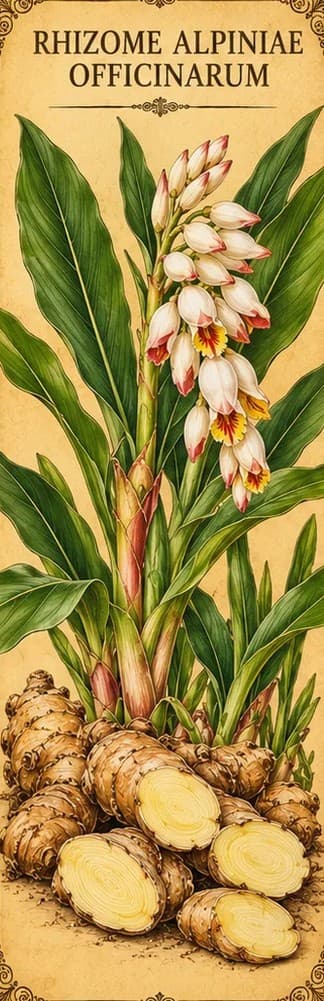
Lesser Galangal
Alpinia officinarum
Gao liang jiang, an aromatic ginger-family rhizome used in Chinese medicine for thousands of years to warm the stomach and relieve stomach pain, vomiting and diarrhoea.
Safety at a glance
- PregnancyNothing recorded
- BreastfeedingNothing recorded
- MedicinesNothing recorded
- Who should avoid itNothing recorded
- AllergiesNothing recorded
- ToxicityNothing recorded
Tap a box to read the safety notes below. “Nothing recorded” means our sources don't cover it, not that it's safe.
What is Lesser Galangal?
- Plant family
- Zingiberaceae, the ginger family
- Parts used
- The dried aromatic root and rhizome
- Genus
- Alpinia
- Species
- officinarum
Also called
Galangal, Rhizome Alpiniae Officinarum, Alpiniae Officinarum Rhizoma
Traditional names
Gao Liang Jiang, Liangjiang
Traditionally used for
- Cold
- painful stomach (traditional)
- Vomiting and diarrhoea (traditional)
- Indigestion and acid reflux
Traditionally described as
- Protected against stomach ulcers (in animal studies)
Health topics
Where Lesser Galangal appears in symptom search, and why. Being listed doesn't mean it's a proven treatment.
- Fertility
In one trial, lesser galangal extract improved sperm count and shape in men with unexplained infertility.
- Indigestion
A traditional Chinese remedy for a cold, painful stomach and indigestion. Not tested on its own in trials.
- Occasional Nausea
Traditionally used for vomiting. Not tested in trials.
- Stomach Ulcers and H. pylori
Protected against stomach ulcers in animal studies. Not tested in people.
Traditions that use it
- Traditional Chinese Medicine
First recorded in the Ming Yi Bie Lu; used for thousands of years to warm the stomach, dispel cold and relieve stomach pain, vomiting and diarrhoea.
How it's prepared
Common ways Lesser Galangal is prepared or sold. This isn't advice on how to take it; see Safety below.
- Decoction
It's also taken as a decoction.[1]Study
- Tea / Infusion
The rhizomes are traditionally brewed as a tea.[2]Study
What does the research say?
Traditional use
These are traditional uses, not proven treatments.
Lesser galangal was first recorded in the Ming Yi Bie Lu during the Han Dynasty and has been used in Chinese medicine for thousands of years. It's described as pungent and warm, and is used to warm the stomach, dispel cold and relieve pain, mainly for:
- Cold, painful stomach
- Vomiting
- Diarrhoea
- Food sitting heavy in the stomach
Today it's used mainly for digestive problems such as indigestion, acid reflux and stomach ulcers.[1]Study
Laboratory & animal research
Lab and animal results show what might be worth studying in people. They don't show that the herb has these effects in humans.
In lab and animal studies, galangal and its compounds (flavonoids such as galangin, and diarylheptanoids) protected against stomach ulcers, changed gut movement, may help reduce inflammation and pain, acted as antioxidants, slowed tumours, killed bacteria and lowered blood sugar. These are lab and animal results.[1]Study
Research in people
In an Iranian trial, 60 men with unexplained infertility took 300 mg a day of lesser galangal extract or a dummy pill for 3 months. Sperm count and the share of normally shaped sperm rose in the galangal group, and the researchers didn't report any side effects.[3]Study
Sources
- [1] Alpinia officinarum Hance: a comprehensive review of traditional uses, phytochemistry, pharmacokinetic and pharmacology · DOI: 10.3389/fphar.2024.1414635Peer-reviewed study
- [2] A Review on the Pharmacological Activities and Phytochemicals of Alpinia officinarum (Galangal) Extracts Derived from Bioassay-Guided Fractionation and Isolation · DOI: 10.4103/phrev.phrev_55_16Peer-reviewed study
- [3] Effect of Alpinia officinarum Hance rhizome extract on spermatogram factors in men with idiopathic infertility: A prospective double-blinded randomised clinical trial · DOI: 10.1111/and.13172Peer-reviewed study
This information is educational and traditional in nature, and is not a substitute for professional medical advice. Unfamiliar word? See what these words mean.