
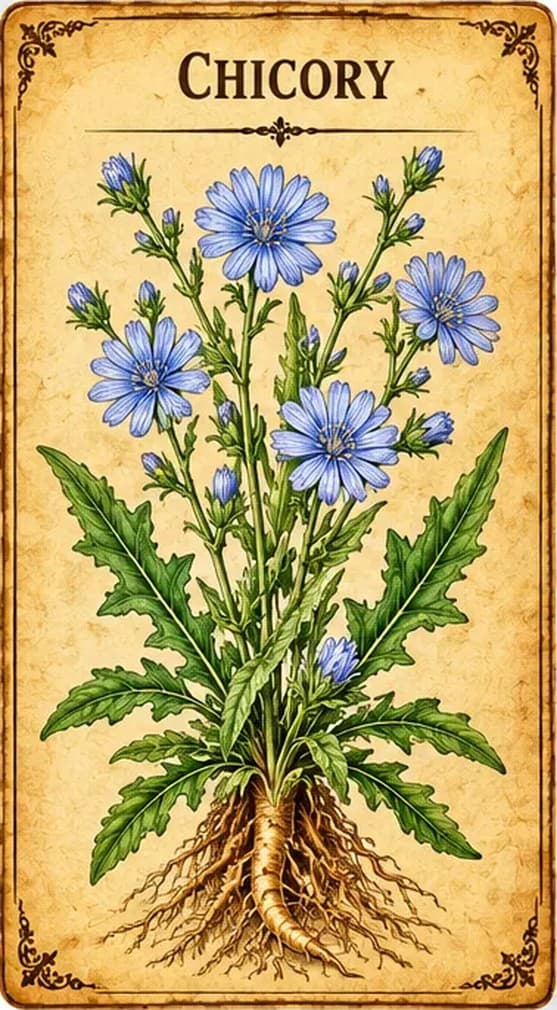
Chicory
Cichorium intybus
A plant whose root is made into tea. Recognized in Europe as a traditional remedy for mild digestive problems and loss of appetite.
Safety at a glance
- Pregnancy1 note →
- Breastfeeding1 note →
- MedicinesNothing recorded
- Who should avoid it1 note →
- Allergies1 note →
- ToxicityNothing recorded
Tap a box to read the safety notes below. “Nothing recorded” means our sources don't cover it, not that it's safe.
What is Chicory?
- Plant family
- Asteraceae, the daisy family
- Parts used
- The root
- Genus
- Cichorium
- Species
- intybus
Also called
Chicory Root
Traditionally used for
- Digestion
- Appetite
Traditionally described as
- Root tea
Health topics
Where Chicory appears in symptom search, and why. Being listed doesn't mean it's a proven treatment.
- Bloating
Recognized in Europe as a traditional remedy for feeling overly full and gas.
- Indigestion
Recognized in Europe as a traditional remedy for mild digestive problems such as slow digestion.
- Loss of Appetite
Recognized in Europe as a traditional remedy for temporary loss of appetite.
How it's prepared
Common ways Chicory is prepared or sold. This isn't advice on how to take it; see Safety below.
- Decoction
The cut root can also be simmered in water as a decoction, once a day.[1]Health agency
- Tea / Infusion
The cut root is steeped in boiling water as an herbal tea, once a day.[1]Health agency
Safety
Who should avoid it
Not recommended for children under 12, because there isn't enough data. See a doctor if symptoms get worse or last longer than 2 weeks.[1]Health agency
Allergies
Don't use chicory root if you're allergic to it or to other plants in the daisy family.[1]Health agency
Side effects
No side effects or drug interactions were known when the European Medicines Agency assessed it.[1]Health agency
Pregnancy
Safety in pregnancy hasn't been established, so it isn't recommended.[1]Health agency
Breastfeeding
Safety while breastfeeding hasn't been established, so it isn't recommended.[1]Health agency
What does the research say?
Traditional use
These are traditional uses, not proven treatments.
Based on long-standing use, the European Medicines Agency recognizes chicory root as a traditional herbal medicine for mild digestive problems, such as feeling overly full, gas and slow digestion, and for temporary loss of appetite. This is based on traditional use only, not on clinical trials.[1]Health agency
In short
Avoid if allergic to the daisy family. Not recommended in pregnancy, while breastfeeding or for children under 12.
Sources
- [1] Community herbal monograph on Cichorium intybus L., radix — European Medicines Agency, Committee on Herbal Medicinal Products (HMPC)Government health agency
This information is educational and traditional in nature, and is not a substitute for professional medical advice. Unfamiliar word? See what these words mean.