
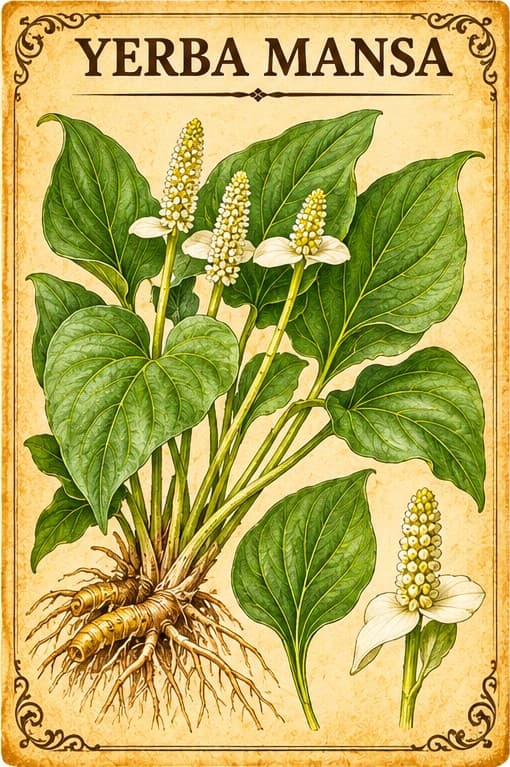
Yerba Mansa
Anemopsis californica
A plant of the Southwest and California, one of the region's most used Native American remedies for wounds, colds and sore throats. Its root compounds stopped some germs in lab tests.
Safety at a glance
- Pregnancy1 note →
- BreastfeedingNothing recorded
- MedicinesNothing recorded
- Who should avoid itNothing recorded
- AllergiesNothing recorded
- ToxicityNothing recorded
Tap a box to read the safety notes below. “Nothing recorded” means our sources don't cover it, not that it's safe.
What is Yerba Mansa?
- Plant family
- Saururaceae, the lizard's-tail family
- Parts used
- The roots, leaves and whole plant
- Where it grows
- Southwestern US and northern Mexico
- Genus
- Anemopsis
- Species
- californica
Traditionally used for
- Wounds
- Colds
- Sore throat
- Stomach ulcers (traditional)
Traditionally described as
- Roots contain sesamin
- asarinin and aromatic oils
Health topics
Where Yerba Mansa appears in symptom search, and why. Being listed doesn't mean it's a proven treatment.
- Colds and Nasal Congestion
Many Southwestern peoples drank a root or plant tea for colds and chest congestion. Not studied in people.
- Cuts, Wounds, Burns and Skin Ulcers
A widely used Native American wound and sore remedy. Root compounds stopped some germs in lab tests; not tested in people.
- Menstrual Discomfort
The Costanoan used a root decoction for menstrual cramps. Not studied in people.
- Sore Throat
The Pima held the dry root in the mouth for sore throats. Not studied in people.
- Stomach Ulcers and H. pylori
The Cahuilla drank it for stomach ulcers. Not studied in people.
Traditions that use it
- Native American Ethnobotany
Used by the Cahuilla, Chumash, Pima, Shoshoni, Paiute, Kawaiisu, Costanoan, Isleta and other peoples of the Southwest and California.
Natural compounds
How it's prepared
Common ways Yerba Mansa is prepared or sold. This isn't advice on how to take it; see Safety below.
- Decoction
Root boiled in water, taken for colds, coughs, stomachaches and pain.[1]Traditional text
- Powder
Dried, powdered plant dusted on wounds.[1]Traditional text
Safety
Pregnancy
The Chumash used yerba mansa together with tobacco to end pregnancies. It isn't known how the two were used or which caused the effect.[2]Study
What does the research say?
Traditional use
These are traditional uses, not proven treatments.
Across the Southwest and California, yerba mansa was a wound remedy. The Costanoan and Mahuna dusted the dried, powdered plant on wounds to clean them, the Isleta put damp leaves on open wounds, the Western Keres put chewed leaves on burns, and many peoples washed sores with a tea of it.[1]Traditional text
A tea or decoction of the root or plant was taken for colds, coughs and chest congestion by the Cahuilla, Pima, Kawaiisu, Shoshoni and Tubatulabal. The Pima held the dry root in the mouth for sore throats.[1]Traditional text
The Cahuilla drank it for stomach ulcers and the Shoshoni for stomachaches. The Costanoan used a root decoction for menstrual cramps and general pain, and the Paiute bathed sore muscles and feet in a leaf decoction.[1]Traditional text
Yerba mansa was a popular remedy for venereal diseases among the Chumash and other California peoples, and was still used for them in Spanish Mission times.[2]Study
Laboratory & animal research
Lab and animal results show what might be worth studying in people. They don't show that the herb has these effects in humans.
In lab tests, root extracts slowed the growth of colon and breast cancer cells.[3]Study
The root oil varies a lot from plant to plant. New Mexico plants fell into three types, rich in elemicin, methyleugenol, or piperitone and thymol. In lab tests the root oil slowed the growth of cervical and uterine cancer cells, but not lung, breast, prostate or colon cancer cells.[4]Study
Two compounds from the roots, sesamin and asarinin, stopped the growth of several nontuberculous mycobacteria, germs that can cause skin, lung and lymph node infections, in lab tests. The roots contain much more of them than the leaves.[5]Study
In lab tests, leaf and stem extracts didn't cause DNA mutations in bacteria, and reduced the mutations caused by a cancer-causing chemical.[6]Study
In lab tests on skin cells, a yerba mansa extract calmed inflammation and protected collagen from damage caused by UVB rays from the sun.[7]Study
In short
Was used by the Chumash to end pregnancies; avoid in pregnancy.
Sources
- [1] Native American Ethnobotany Database: Anemopsis californica — Botanical Research Institute of Texas (BRIT); compiled by Daniel E. MoermanTraditional text
- [2] Women's health among the Chumash · DOI: 10.1093/ecam/nek021Peer-reviewed study
- [3] In vitro anticancer activity of Anemopsis californica · DOI: 10.3892/ol_00000124Peer-reviewed study
- [4] Chemotypic variation of essential oils in the medicinal plant, Anemopsis californica · DOI: 10.1016/j.phytochem.2007.11.006Peer-reviewed study
- [5] Antimycobacterial furofuran lignans from the roots of Anemopsis californica · DOI: 10.1055/s-0034-1368352Peer-reviewed study
- [6] Antimutagenicity of Methanolic Extracts from Anemopsis californica in Relation to Their Antioxidant Activity · DOI: 10.1155/2014/273878Peer-reviewed study
- [7] Anemopsis californica Attenuates Photoaging by Regulating MAPK, NRF2, and NFATc1 Signaling Pathways · DOI: 10.3390/antiox10121882Peer-reviewed study
This information is educational and traditional in nature, and is not a substitute for professional medical advice. Unfamiliar word? See what these words mean.