
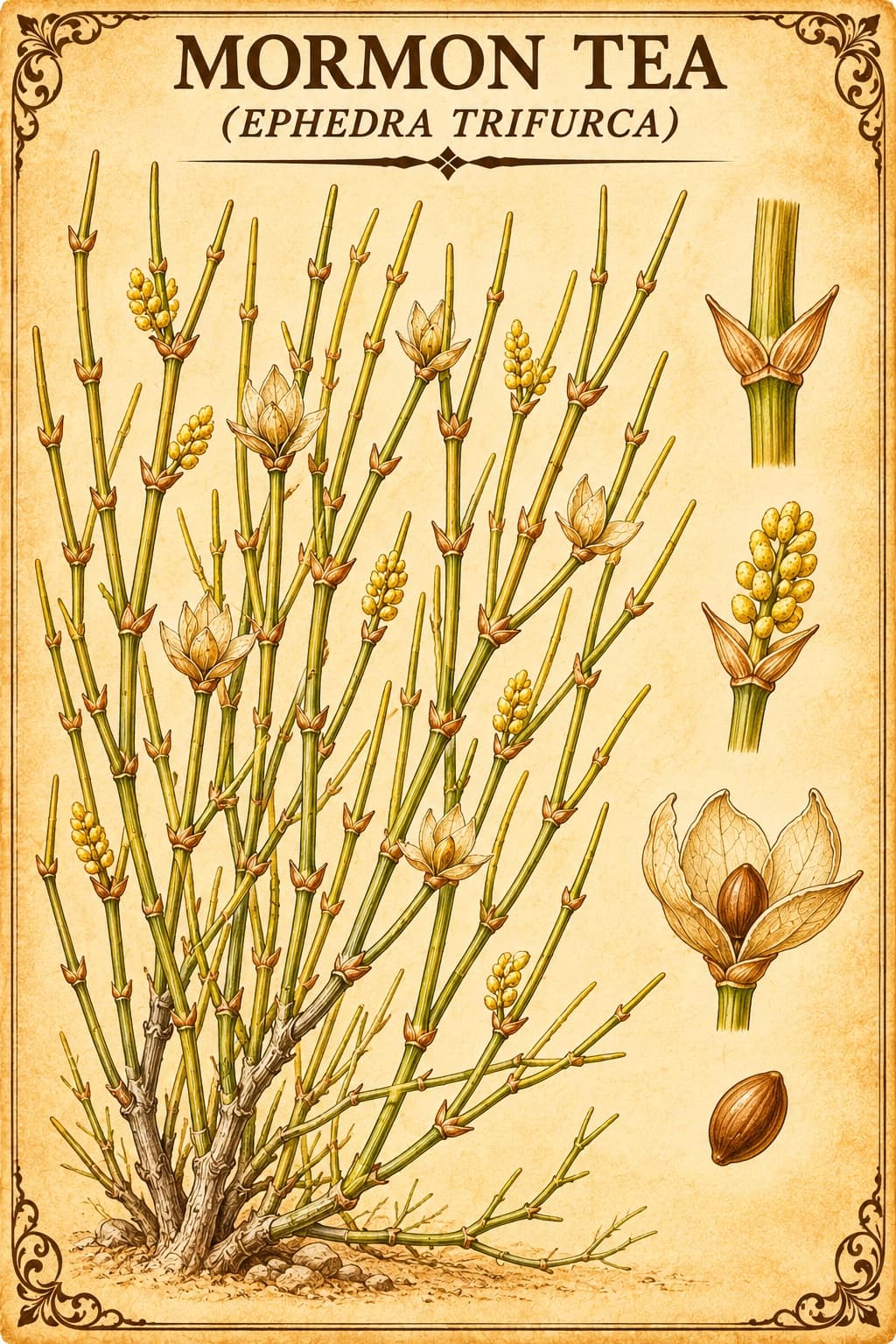
Mormon Tea
Ephedra trifurca
A jointfir shrub of the Southwest, drunk as a tea by the Navajo for stomach and kidney troubles. It's thought to lack the ephedrine in Chinese ephedra, but this is uncertain.
Safety at a glance
- PregnancyNothing recorded
- BreastfeedingNothing recorded
- MedicinesNothing recorded
- Who should avoid itNothing recorded
- AllergiesNothing recorded
- Toxicity2 notes →
Tap a box to read the safety notes below. “Nothing recorded” means our sources don't cover it, not that it's safe.
What is Mormon Tea?
- Plant family
- Ephedraceae, the jointfir family
- Parts used
- The green stems
- Where it grows
- Southwestern US and northern Mexico
- Genus
- Ephedra
- Species
- trifurca
Also called
Longleaf Jointfir
Regional names
Popotillo, Cola de Zorra, Tepopote
Traditionally used for
- Stomach troubles
- Kidney problems
- Sores (traditional)
Traditionally described as
- Green jointed stems
Health topics
Where Mormon Tea appears in symptom search, and why. Being listed doesn't mean it's a proven treatment.
- Cuts, Wounds, Burns and Skin Ulcers
Ground or boiled stems were put on sores by the Cocopa. Not studied in people.
- Indigestion
The Navajo drank a tea of the dried plant for stomach troubles. Not studied in people.
Traditions that use it
- Native American Ethnobotany
Used by the Navajo, Pima (O'odham) and Cocopa peoples.
How it's prepared
Common ways Mormon Tea is prepared or sold. This isn't advice on how to take it; see Safety below.
- Tea / Infusion
Tea of the dried plant taken by the Navajo for stomach and kidney troubles.[1]Traditional text
Safety
Toxicity testing
American Ephedra species like Mormon tea are thought to lack ephedrine, the stimulant in Chinese ephedra, but a few reports say they do contain it, so this is unclear. Very few studies have looked at what they contain or how they affect the body.[2]Study
Chinese ephedra (a related species, Ephedra sinica) has been linked to high blood pressure, heart attack, seizure, stroke and psychosis, and the FDA banned supplements containing ephedrine in 2004. It's considered unsafe in pregnancy, while breastfeeding and for children.[3]Health agency
What does the research say?
Traditional use
These are traditional uses, not proven treatments.
The Navajo drank a tea of the dried plant for stomach troubles, kidney problems and venereal disease.[1]Traditional text
The Cocopa put ground or boiled stems on sores. The Pima (O'odham) put the plant on bleeding sores and burned the dried plant on the skin, like moxibustion, to treat boils and sores.[1]Traditional text
In short
Related Chinese ephedra is banned in US supplements; whether this species contains ephedrine is unclear.
Sources
- [1] Native American Ethnobotany Database: Ephedra trifurca — Botanical Research Institute of Texas (BRIT); compiled by Daniel E. MoermanTraditional text
- [2] A Review of the Ephedra genus: Distribution, Ecology, Ethnobotany, Phytochemistry and Pharmacological Properties · DOI: 10.3390/molecules25143283Peer-reviewed study
- [3] Ephedra — National Center for Complementary and Integrative Health (NCCIH), NIHGovernment health agency
This information is educational and traditional in nature, and is not a substitute for professional medical advice. Unfamiliar word? See what these words mean.