
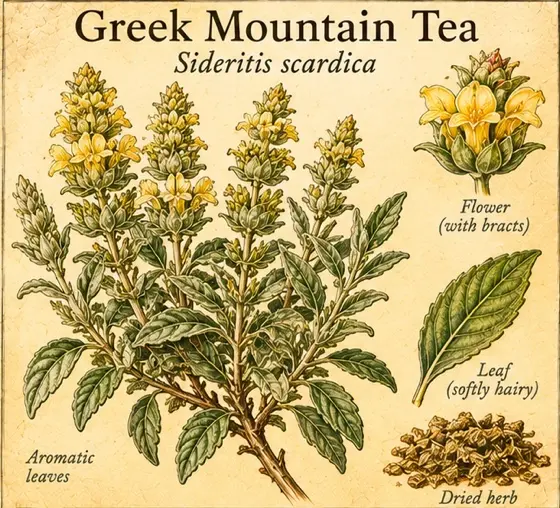
Greek Mountain Tea
Sideritis scardica
A mint-family mountain herb of Greece and the Balkans, drunk as a tea. Europe accepts it as a traditional remedy for coughs with colds and mild stomach upsets, and one trial found an extract eased anxiety in older adults.
Safety at a glance
- Pregnancy1 note →
- BreastfeedingNothing recorded
- MedicinesNothing recorded
- Who should avoid itNothing recorded
- Allergies1 note →
- ToxicityNothing recorded
Tap a box to read the safety notes below. “Nothing recorded” means our sources don't cover it, not that it's safe.
What is Greek Mountain Tea?
- Plant family
- Lamiaceae, the mint family
- Parts used
- The dried flowering tops (aerial parts)
- Where it grows
- Mountains of the Balkans and the eastern Mediterranean
- Genus
- Sideritis
- Species
- scardica
Also called
Ironwort, Shepherd's Tea, Mountain Tea
Traditional names
Tsai tou vounou, Sideritis Herba
Traditionally used for
- Cough with a cold (traditional)
- Mild stomach discomfort (traditional)
- Anxiety and attention (studied)
Traditionally described as
- Aromatic tea rich in verbascoside and flavonoids
Health topics
Where Greek Mountain Tea appears in symptom search, and why. Being listed doesn't mean it's a proven treatment.
- Anxiety
In one trial in older adults, a daily extract reduced anxiety after 28 days.
- Cough
Accepted in Europe as a traditional remedy for cough with a cold.
- Indigestion
Accepted in Europe as a traditional remedy for mild stomach and gut discomfort.
- Memory and Thinking
One trial found small improvements in attention in healthy older adults.
Traditions that use it
- Mediterranean Folk Medicine
Drunk as a herbal tea in Greece and the Balkans for coughs and colds and for mild stomach upsets.
Natural compounds
How it's prepared
Common ways Greek Mountain Tea is prepared or sold. This isn't advice on how to take it; see Safety below.
- Extract
Dried extracts of 475 to 1,500 mg a day were used in trials.[1]Study
- Tea / Infusion
2 to 4 g of the dried herb steeped in 150 to 200 mL of hot water, 2 to 3 times a day.[2]Health agency
Safety
Allergies
Don't use it if you're allergic to Sideritis or to other plants in the mint family, such as mint, sage, thyme or lavender.[2]Health agency
Technical detail: hypersensitivity to plants of the Lamiaceae (Labiatae) family.
Side effects
No side effects or medicine interactions are known. See a doctor if your symptoms get worse while using it.[2]Health agency
Pregnancy
Its safety in pregnancy and breastfeeding hasn't been established, so it isn't recommended at these times. It isn't recommended for children and teenagers under 18 either, because of a lack of data.[2]Health agency
What does the research say?
Traditional use
These are traditional uses, not proven treatments.
Greek mountain tea comes from several kinds of Sideritis, aromatic plants of the mint family from the mountains of the Mediterranean and Balkans. Based on long-standing use, European regulators accept it as a traditional herbal medicine for:
- Relief of cough that comes with a cold
- Relief of mild stomach and gut discomfort
This is based on long use, not on clinical trials.[2]Health agency
Technical detail: traditional-use indications covering S. scardica, S. clandestina, S. raeseri and S. syriaca, herba.
The European guidance for adults is 2 to 4 g of the cut dried herb steeped in 150 to 200 mL of hot water as a tea, 2 to 3 times a day, up to 12 g a day. See a doctor if a cough lasts more than 1 week, or stomach discomfort more than 2 weeks.[2]Health agency
Laboratory & animal research
Lab and animal results show what might be worth studying in people. They don't show that the herb has these effects in humans.
Sideritis plants are rich in plant compounds such as verbascoside and flavonoids. In lab and animal studies, these compounds reduced inflammation, acted as antioxidants and protected brain cells. In lab tests, extracts also slowed the brain's recycling of the chemical messengers serotonin, noradrenaline and dopamine.[3]Study
Technical detail: NF-κB and NLRP3 inflammasome modulation; triple monoamine reuptake inhibition in vitro; ADAM10 upregulation and amyloid-β clearance in transgenic mice.
Research in people
In a trial of 155 healthy adults aged 50 to 70, people took a Greek mountain tea extract (475 or 950 mg), ginkgo or a placebo every day for 28 days. After 28 days, the higher dose reduced anxiety compared with both placebo and ginkgo, and led to fewer errors on an attention task. On the first day, both doses raised oxygen levels in the front of the brain during demanding tasks.[1]Study
Technical detail: randomized, double-blind, placebo-controlled, parallel groups; fewer false alarms on the Rapid Visual Information Processing task; state anxiety reduced; prefrontal oxygenated haemoglobin measured by near-infrared spectroscopy.
In a small trial, 28 healthy adults took 1,500 mg a day of a Greek mountain tea extract or a placebo for 4 weeks. The authors reported improvements in blood pressure, fitness, liver measures and the body's antioxidant status, and found the extract safe to use.[4]Study
Technical detail: SidTea+ extract; VO2max rose by 1.1 mL/kg/min; randomized, double-blind, placebo-controlled.
In short
Avoid if allergic to mint-family plants. Not recommended in pregnancy, breastfeeding or under 18.
Sources
- [1] The Acute and Chronic Cognitive and Cerebral Blood Flow Effects of a Sideritis scardica (Greek Mountain Tea) Extract: A Double Blind, Randomized, Placebo Controlled, Parallel Groups Study in Healthy Humans · DOI: 10.3390/nu10080955Peer-reviewed study
- [2] European Union herbal monograph on Sideritis scardica Griseb.; Sideritis clandestina (Bory & Chaub.) Hayek; Sideritis raeseri Boiss. & Heldr.; Sideritis syriaca L., herba (EMA/HMPC/39453/2015) — European Medicines Agency, Committee on Herbal Medicinal Products (HMPC)Government health agency
- [3] Bioactive Compounds of Sideritis Species in Inflammation, Neuroprotection and Cardiometabolic Health: A Review · DOI: 10.3390/ijms27146217Peer-reviewed study
- [4] Characterization of the Sideritis scardica Extract SidTea+TM and Its Effect on Physiological Profile, Metabolic Health and Redox Biomarkers in Healthy Adults: A Randomized, Double-Blind, Placebo-Controlled Study · DOI: 10.3390/molecules29051113Peer-reviewed study
This information is educational and traditional in nature, and is not a substitute for professional medical advice. Unfamiliar word? See what these words mean.