
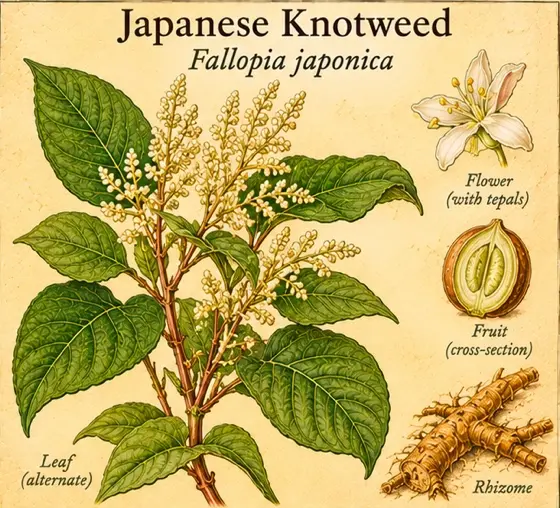
Japanese Knotweed
Reynoutria japonica
An invasive weed in the West but a common Chinese medicine (hu zhang), rich in resveratrol. Herbal mixtures containing it slightly improved acute respiratory infections in trials.
Safety at a glance
- PregnancyNothing recorded
- BreastfeedingNothing recorded
- MedicinesNothing recorded
- Who should avoid itNothing recorded
- AllergiesNothing recorded
- ToxicityNothing recorded
Tap a box to read the safety notes below. “Nothing recorded” means our sources don't cover it, not that it's safe.
What is Japanese Knotweed?
- Plant family
- Polygonaceae, the buckwheat and dock family
- Parts used
- The rhizome and root
- Where it grows
- East Asia (Japan, China and Korea); invasive in Europe and North America
- Genus
- Reynoutria
- Species
- japonica
Also called
Mexican Bamboo
Traditional names
Hu Zhang, Itadori
Older scientific names
Polygonum cuspidatum, Fallopia japonica
Traditionally used for
- Cough and respiratory infections (traditional and studied in mixtures)
- Jaundice and hepatitis (traditional)
Traditionally described as
- Root rich in resveratrol
- polydatin and emodin
Health topics
Where Japanese Knotweed appears in symptom search, and why. Being listed doesn't mean it's a proven treatment.
- Colds and Nasal Congestion
Herbal mixtures with knotweed slightly improved acute respiratory infections in trials.
- Cough
Traditionally used to ease cough and clear phlegm.
- Liver Disease (Hepatitis, Cirrhosis)
Traditionally used for jaundice and hepatitis; its compounds protected the liver in animals.
Traditions that use it
- Traditional Chinese Medicine
Known as hu zhang, the root is used to clear heat, improve blood and energy (qi) flow, clear phlegm and ease cough, and for jaundice and hepatitis.
Natural compounds
How it's prepared
Common ways Japanese Knotweed is prepared or sold. This isn't advice on how to take it; see Safety below.
- Decoction
The root is boiled as part of traditional Chinese herbal formulas.[1]Review or trial
Safety
Side effects
In the respiratory trials, herbal mixtures containing knotweed appeared safe. Its safety when taken on its own hasn't been tested in trials.[1]Review or trial
What does the research say?
Traditional use
These are traditional uses, not proven treatments.
Japanese knotweed is a tall, fast-spreading plant with bamboo-like stems. It's a serious invasive weed in Europe and North America, but in China its root is a common herbal medicine. In traditional Chinese medicine, it's used to clear heat, improve blood and energy (qi) flow, clear phlegm and ease cough. It has also long been used for jaundice, hepatitis and blocked bile flow.[2]Study
Laboratory & animal research
Lab and animal results show what might be worth studying in people. They don't show that the herb has these effects in humans.
The root is rich in resveratrol (the compound also found in red grapes) and its relative polydatin, as well as emodin. In animals with blocked bile flow from the liver, these compounds reduced liver damage, inflammation and scarring. Clinical trials are needed.[2]Study
Technical detail: regulated bile-acid synthesis and transport via FXR, PXR and BSEP; activated Nrf2; suppressed NF-κB and TGF-β; ANIT, bile-duct-ligation and genetic cholestasis models.
Research in people
A 2022 review found 8 trials with 1,123 people with acute chest, throat or sinus infections. Every trial used knotweed as part of a herbal mixture, and nearly all gave it with antibiotics. The mixtures improved symptoms slightly more often than the comparison treatments. The evidence is limited, and knotweed hasn't been tested on its own.[1]Review or trial
Technical detail: symptom improvement rate RR 1.14 (95% CI 1.09–1.20), I² = 0%; PROSPERO CRD42020188604; only one trial used the mixture without antibiotics.
In short
Not tested on its own in trials.
Sources
- [1] Reynoutria japonica Houtt for Acute Respiratory Tract Infections in Adults and Children: A Systematic Review · DOI: 10.3389/fphar.2022.787032Review or clinical trial
- [2] Protective effects of Polygonum cuspidatum bioactive constituents against cholestatic liver injury: A mechanistic review · DOI: 10.1016/j.fitote.2025.106938Peer-reviewed study
This information is educational and traditional in nature, and is not a substitute for professional medical advice. Unfamiliar word? See what these words mean.