
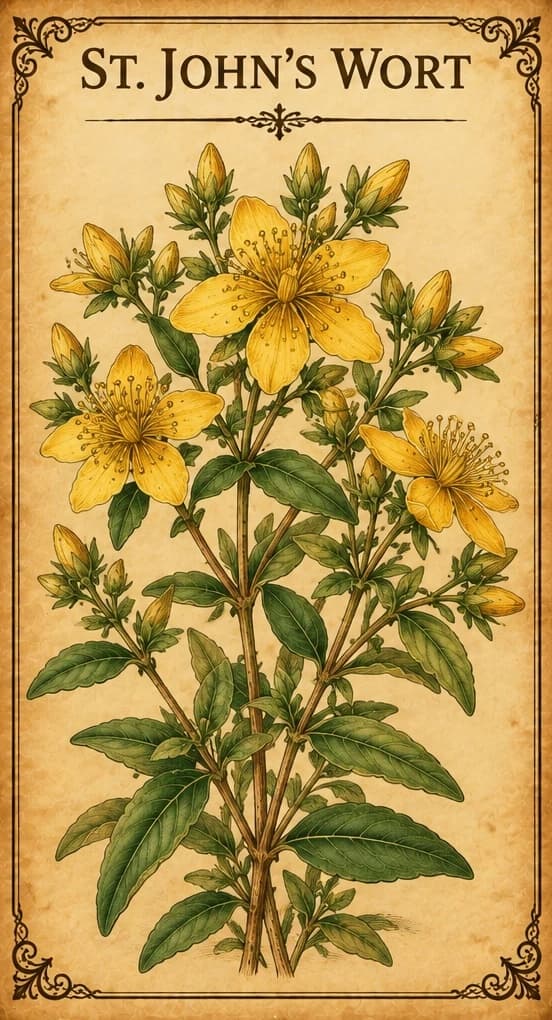
St. John's Wort
Hypericum perforatum
A yellow-flowered herb traditionally used to support mood. It interacts with many common medicines.
Safety at a glance
- Pregnancy1 note →
- Breastfeeding1 note →
- Medicines6 notes →
- Who should avoid it1 note →
- AllergiesNothing recorded
- ToxicityNothing recorded
Tap a box to read the safety notes below. “Nothing recorded” means our sources don't cover it, not that it's safe.
St. John's Wort may interact with some medicines. If you take any medicine, read Interactions with medicines below and talk to your doctor or pharmacist before using it.
What is St. John's Wort?
- Plant family
- Hypericaceae, the St. John's wort family
- Parts used
- The parts above ground: flowering tops, leaves and flowers
- Where it grows
- Native to Europe, Western Asia and North Africa. It now grows wild in many places, including North America and Australia.
- Genus
- Hypericum
- Species
- perforatum
Also called
Klamath Weed, Tipton Weed, Goatweed
Traditional names
Guan Ye Lian Qiao (贯叶连翘)
Older scientific names
Hypericum officinale Gaterau, Hypericum officinarum Crantz, Hypericum vulgare Lam.
Traditionally used for
- Low mood
- Wound salves (on the skin)
Traditionally described as
- Antidepressant-like
- May help reduce inflammation
Health topics
Where St. John's Wort appears in symptom search, and why. Being listed doesn't mean it's a proven treatment.
- Eczema
A hyperforin cream improved mild to moderate atopic dermatitis better than a dummy cream.
Traditions that use it
- Western Herbalism
Historically used for depression, stomach ulcers, colds and wound healing. The name probably comes from the plant blooming around the feast of St. John the Baptist in late June.
- Mediterranean Folk Medicine
In ancient Greek medicine, used for snake bites, stomach upset, menstrual cramps, low mood and wounds.
- Traditional Chinese Medicine
Known as Guan Ye Lian Qiao (贯叶连翘). Historically used for vomiting or coughing up blood, bleeding between periods, irregular periods, bleeding from injuries and wound care.
Technical detail: hematemesis, hemoptysis, metrorrhagia, traumatic hemorrhage.
Natural compounds
How it's prepared
Common ways St. John's Wort is prepared or sold. This isn't advice on how to take it; see Safety below.
- Extract
Dry extracts of the flowering tops are taken by mouth in tablets or capsules. Liquid extracts and juice pressed from the fresh plant are also used.[1]Health agency
- Oil
St. John's wort oil, made by soaking the plant in vegetable oil, is taken by mouth or used on the skin.[1]Health agency
- Salve
The flowers are made into a salve for bruises, burns and nerve pain.[2]General reference
- Tea / Infusion
The dried, cut plant is made into an herbal tea, or steeped to make a liquid for the skin.[1]Health agency
- Tincture
St. John's wort tinctures (alcohol extracts) are taken by mouth or used on the skin.[1]Health agency
Safety
Interactions with medicines
Why St. John's wort interacts with so many medicines: a compound in it called hyperforin speeds up the liver enzymes and "pump" proteins that clear medicines from the body. The stronger the product's hyperforin content, the stronger the interaction.[3]Study
Technical detail: PXR activation inducing CYP3A4, CYP2C19, CYP2C9, CYP1A2, CYP2D6 and P-glycoprotein.
St. John's wort can make many medicines work less well, including:
- Antidepressants
- Birth control pills
- Transplant medicines such as cyclosporine
- Heart medicines such as digoxin and ivabradine
- The pain medicine oxycodone
- HIV medicines such as indinavir and nevirapine
- Cancer medicines such as irinotecan, imatinib and docetaxel
- The blood thinner warfarin
- Seizure medicines such as phenytoin and carbamazepine
- Cholesterol medicines (statins) such as simvastatin
Taken with certain antidepressants or other medicines that raise serotonin, St. John's wort can cause serotonin to build up to dangerous, possibly life-threatening levels (serotonin syndrome). Signs include agitation, diarrhea, a fast heartbeat, high blood pressure, hallucinations and a high body temperature.[5]Health agency
St. John's wort lowers blood levels of the transplant medicines cyclosporine and tacrolimus. This can lead to organ rejection if they're taken together without monitoring.[3]Study
Technical detail: via CYP3A4/P-gp induction.
St. John's wort makes birth control pills less effective, raising the chance of ovulation and breakthrough bleeding.[3]Study
Sun-sensitivity reactions have been seen when St. John's wort is combined with the antibiotic rifampicin, especially in women.[3]Study
Who should avoid it
There are reports of St. John's wort worsening psychotic symptoms in people with bipolar disorder or schizophrenia. Don't use it to replace regular care, or as a reason to put off seeing a health professional about a mental health problem.[5]Health agency
Side effects
Possible side effects include upset stomach, diarrhea, dry mouth, headache, tiredness, dizziness, confusion, sexual problems, trouble sleeping, restlessness and skin tingling.[4]Health agency
St. John's wort can be stimulating and may make anxiety worse in some people.[5]Health agency
Large doses by mouth, or use on the skin, might cause severe skin reactions after time in the sun (photosensitivity).[4]Health agency
Pregnancy
St. John's wort may be unsafe during pregnancy because it may raise the risk of birth defects. There is little safety information on its use by pregnant women.[4]Health agency
Breastfeeding
Babies of mothers taking St. John's wort may have colic, drowsiness or low energy. There is little safety information overall on its use while breastfeeding.[4]Health agency
What does the research say?
Traditional use
These are traditional uses, not proven treatments.
St. John's wort has been widely used in Greek, Islamic and Chinese medicine. Historically, it has been used for depression, stomach ulcers, colds and wound healing.[4]Health agency
In Islamic traditional medicine, it was used for infected wounds, burns and bruises; to increase urination; to bring on menstruation; to lower fever; and for sciatica (nerve pain down the leg). In Traditional Chinese Medicine (as Guan Ye Lian Qiao), it was used for vomiting or coughing up blood, bleeding between periods, irregular periods, bleeding from injuries and wound care.[3]Study
Technical detail: diuretic, emmenagogue, antipyretic; hematemesis, hemoptysis, metrorrhagia, traumatic hemorrhage.
Laboratory & animal research
Lab and animal results show what might be worth studying in people. They don't show that the herb has these effects in humans.
This research explains St. John's wort's drug interactions. A compound in the plant called hyperforin switches on a sensor in the body that speeds up the liver enzymes and "pump" proteins that clear many medicines out of the body. The more hyperforin a product has, the stronger this effect. Low-hyperforin extracts showed little effect.[3]Study
Technical detail: hyperforin activates the pregnane X receptor (PXR), inducing CYP3A4, CYP2C19, CYP2C9, CYP1A2 and CYP2D6, and the efflux transporter P-glycoprotein (P-gp/ABCB1); CYP3A4 induction correlates with hyperforin content.
Research in people
A 2008 Cochrane review pooled 29 high-quality trials with 5,489 people with major depression. The extracts tested worked better than placebo (a dummy pill), about as well as standard antidepressants, and caused fewer side effects. But trials from German-speaking countries were much more positive than trials elsewhere, which makes the results harder to interpret. The findings only apply to the specific extracts tested, and products on the shelf vary a lot in quality.[6]Review or trial
Technical detail: randomized, double-blind trials of hypericum extracts.
Individual trials have had mixed results:
- 2011, 12 weeks, minor depression: neither St. John's wort nor the antidepressant citalopram did better than placebo.
- 2012, 26 weeks, moderate major depression: St. John's wort, the antidepressant sertraline and placebo all worked about equally.
- 2002, moderate major depression: St. John's wort did no better than placebo.
A 2008 review concluded it may be better than placebo, and as effective as standard antidepressants, for mild to moderate major depression.[5]Health agency
St. John's wort may help mild or moderate depression, and seems about as effective as standard antidepressants over periods of up to 12 weeks. It's unclear whether it helps severe depression or works beyond 12 weeks. Limited evidence suggests it might help menopausal hot flashes and somatic symptom disorder (intense distress about physical symptoms). There is little research support for ADHD, irritable bowel syndrome, obsessive-compulsive disorder, PMS, quitting smoking or healing wounds on the skin.[4]Health agency
Used on the skin, a St. John's wort cream standardised to 1.5% hyperforin improved the skin and reduced Staphylococcus aureus bacteria on it in people with mild to moderate atopic dermatitis (eczema), clearly better than a dummy cream, according to a 2013 review. An oil made by soaking the flowering tops in vegetable oil is traditionally used on minor cuts, burns and skin ulcers.[7]Study
In short
Interacts with many medicines, including antidepressants and birth control pills.
Sources
- [1] European Union herbal monograph on Hypericum perforatum L., herba — European Medicines Agency, Committee on Herbal Medicinal Products (HMPC)Government health agency
- [2] St. John's Wort — Herban Herbalist materia medica — Herban Herbalist (herb shop)General reference
- [3] Hypericum perforatum: Traditional uses, clinical trials, and drug interactions — Iranian Journal of Basic Medical Sciences · DOI: 10.22038/IJBMS.2022.65112.14338Peer-reviewed study
- [4] St. John's Wort: Usefulness and Safety — National Center for Complementary and Integrative Health (NIH)Government health agency
- [5] St. John's Wort and Depression: In Depth — National Center for Complementary and Integrative Health (NIH)Government health agency
- [6] St John's wort for major depression — Cochrane Database of Systematic Reviews · DOI: 10.1002/14651858.CD000448.pub3Review or clinical trial
- [7] Medicinal plants used in treatment of inflammatory skin diseases — Postępy Dermatologii i Alergologii · DOI: 10.5114/pdia.2013.35620Peer-reviewed study
This information is educational and traditional in nature, and is not a substitute for professional medical advice. Unfamiliar word? See what these words mean.