
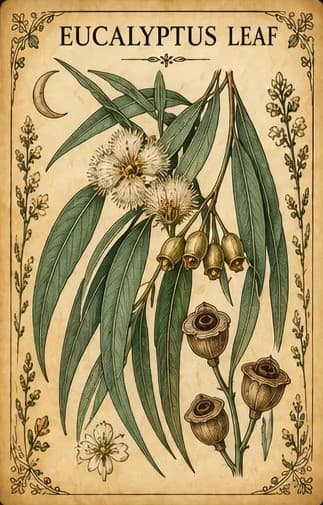
Eucalyptus
Eucalyptus globulus
Leaves of the eucalyptus tree, taken as tea or inhaled in steam, and recognized in Europe as a traditional medicine for cough with a cold.
Safety at a glance
- PregnancyNothing recorded
- BreastfeedingNothing recorded
- MedicinesNothing recorded
- Who should avoid it1 note →
- AllergiesNothing recorded
- ToxicityNothing recorded
Tap a box to read the safety notes below. “Nothing recorded” means our sources don't cover it, not that it's safe.
What is Eucalyptus?
- Plant family
- Myrtaceae, the myrtle family
- Parts used
- The leaves
- Genus
- Eucalyptus
- Species
- globulus
Also called
Eucalyptus Leaf
Traditionally used for
- Cough
- Colds
- Steam inhalation
- Tea
Traditionally described as
- May help loosen mucus (traditional)
Health topics
Where Eucalyptus appears in symptom search, and why. Being listed doesn't mean it's a proven treatment.
- Colds and Nasal Congestion
Used as a tea or steam inhalation for cough with a cold. Never use it in children under 2½.
- Cough
Recognized in Europe as a traditional medicine for cough with a cold.
Traditions that use it
- European Folk Medicine
Recognized in Europe as a traditional herbal medicine for cough with a cold.
Natural compounds
How it's prepared
Common ways Eucalyptus is prepared or sold. This isn't advice on how to take it; see Safety below.
- Essential Oil
The essential oil is diluted in a carrier oil and rubbed on the chest, or a few drops are added to hot water to breathe in the steam.[1]General reference
- Tea / Infusion
The dried, cut leaves are made into an herbal tea, or steeped in hot water so the steam can be breathed in.[2]Health agency
- Tincture
Eucalyptus leaf tinctures (alcohol extracts) are taken by mouth.[2]Health agency
Safety
Who should avoid it
Never use eucalyptus leaf in children under 30 months (2½ years): products containing cineole, like other essential oils, can cause a sudden tightening of the vocal cords (laryngospasm).[2]Health agency
Side effects
No side effects have been reported when used as directed.[3]Health agency
How much to use
Leaf teas and inhalations aren't recommended under 12, and tinctures are for adults only because of their alcohol. See a doctor if symptoms last more than a week, or if you get shortness of breath, fever or colored phlegm.[2]Health agency
What does the research say?
Traditional use
These are traditional uses, not proven treatments.
Based on long-standing use, the European Medicines Agency recognizes eucalyptus leaf as a traditional herbal medicine to relieve cough with a cold. It is taken as a tea or breathed in with steam from hot water.[3]Health agency
Research in people
Lab tests and studies in patients looked at 1,8-cineole (eucalyptol), a compound in eucalyptus leaf. They suggest it might have an effect in airway diseases, but the leaf itself hasn't been proven in trials.[3]Health agency
In short
Never use it in children under 30 months: it can cause a dangerous tightening of the vocal cords.
Sources
- [1] Eucalyptus — Herban Herbalist materia medica — Herban Herbalist (herb shop)General reference
- [2] Community herbal monograph on Eucalyptus globulus Labill., folium (EMA/HMPC/892618/2011) — European Medicines Agency, Committee on Herbal Medicinal Products (HMPC)Government health agency
- [3] Eucalyptus leaf (Eucalyptus globulus Labill., folium): summary of the HMPC conclusions (EMA/HMPC/300235/2013) — European Medicines Agency, Committee on Herbal Medicinal Products (HMPC)Government health agency
This information is educational and traditional in nature, and is not a substitute for professional medical advice. Unfamiliar word? See what these words mean.