
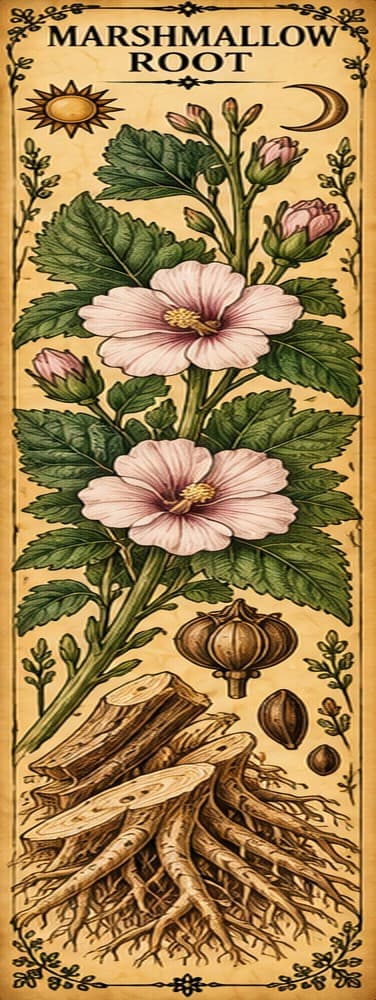
Marshmallow Root
Althaea officinalis
A root recognized in Europe as a traditional medicine for mouth and throat irritation with a dry cough, and for mild stomach and gut discomfort.
Safety at a glance
- Pregnancy1 note →
- BreastfeedingNothing recorded
- Medicines1 note →
- Who should avoid itNothing recorded
- AllergiesNothing recorded
- ToxicityNothing recorded
Tap a box to read the safety notes below. “Nothing recorded” means our sources don't cover it, not that it's safe.
Marshmallow Root may interact with some medicines. If you take any medicine, read Interactions with medicines below and talk to your doctor or pharmacist before using it.
What is Marshmallow Root?
- Plant family
- Malvaceae, the mallow family
- Parts used
- The root
- Genus
- Althaea
- Species
- officinalis
Also called
Marshmallow, Althaea
Traditionally used for
- Stomach discomfort
- Sore throat
- Dry cough
Traditionally described as
- Soothing (traditional)
Health topics
Where Marshmallow Root appears in symptom search, and why. Being listed doesn't mean it's a proven treatment.
- Cough
Recognized in Europe for dry cough; small studies suggest it may reduce coughing.
- Eczema
Used on the skin for eczema and dermatitis; an ointment eased irritated skin, though less than a steroid.
- Indigestion
Recognized in Europe as a traditional medicine for mild stomach and gut discomfort.
- Sore Throat
Recognized in Europe for throat irritation with dry cough.
Traditions that use it
- European Folk Medicine
Recognized in Europe as a traditional herbal medicine for mouth and throat irritation with dry cough, and mild stomach and gut discomfort.
How it's prepared
Common ways Marshmallow Root is prepared or sold. This isn't advice on how to take it; see Safety below.
- Decoction
Herbalists simmer 1 to 2 teaspoons of the root in a cup of water for 10 to 15 minutes. A cold infusion helps keep its slimy mucilage.[1]General reference
- Extract
Dry and liquid extracts of the root are taken by mouth or used in the mouth. The root can also be soaked in cold water to make a liquid for the mouth and throat.[2]Health agency
- Poultice
The root or leaf is applied as a poultice for skin irritation.[1]General reference
- Syrup
The root is soaked in cold water and the liquid made into a syrup.[2]Health agency
- Tea / Infusion
The dried, cut root is made into an herbal tea.[2]Health agency
- Tincture
Herbalists use it as a tincture.[1]General reference
Safety
Interactions with medicines
Marshmallow root may slow the absorption of other medicines. Take it at least 30 to 60 minutes before or after other medicines.[2]Health agency
Side effects
No side effects are known.[2]Health agency
Pregnancy
Its safety during pregnancy and breastfeeding hasn't been established, so it isn't recommended at these times.[2]Health agency
How much to use
Not recommended for children under 3. See a doctor if throat symptoms last more than a week or stomach symptoms more than 2 weeks, or if you get shortness of breath, fever or colored phlegm.[2]Health agency
What does the research say?
Traditional use
These are traditional uses, not proven treatments.
Based on long-standing use, the European Medicines Agency recognizes marshmallow root as a traditional herbal medicine for:
- Mouth or throat irritation and the dry cough that goes with it (from age 3)
- Mild stomach and gut discomfort (from age 12)
The root is usually soaked in cold water to make a drink, or taken as a syrup or extract.[3]Health agency
Marshmallow root is used on the skin for boils, eczema and dermatitis. In people, an ointment with 20% marshmallow root extract reduced skin irritation from UV light or a chemical irritant, though less than a steroid ointment (dexamethasone); combining the two worked best.[4]Study
Research in people
Two studies of marshmallow root syrup in about 900 children with throat irritation and dry cough found coughing improved, but there was no comparison group. In 63 adults with dry cough, marshmallow root drops reduced cough while placebo didn't. The studies had limitations, so firm conclusions can't be drawn.[3]Health agency
In short
May slow absorption of other medicines; take it at least 30 to 60 minutes apart from them.
Sources
- [1] Marsh Mallow — Herban Herbalist materia medica — Herban Herbalist (herb shop)General reference
- [2] European Union herbal monograph on Althaea officinalis L., radix — European Medicines Agency, Committee on Herbal Medicinal Products (HMPC)Government health agency
- [3] Marshmallow root (Althaea officinalis L., radix): summary of the HMPC conclusions (EMA/570566/2016) — European Medicines Agency, Committee on Herbal Medicinal Products (HMPC)Government health agency
- [4] Medicinal plants used in treatment of inflammatory skin diseases — Postępy Dermatologii i Alergologii · DOI: 10.5114/pdia.2013.35620Peer-reviewed study
This information is educational and traditional in nature, and is not a substitute for professional medical advice. Unfamiliar word? See what these words mean.