
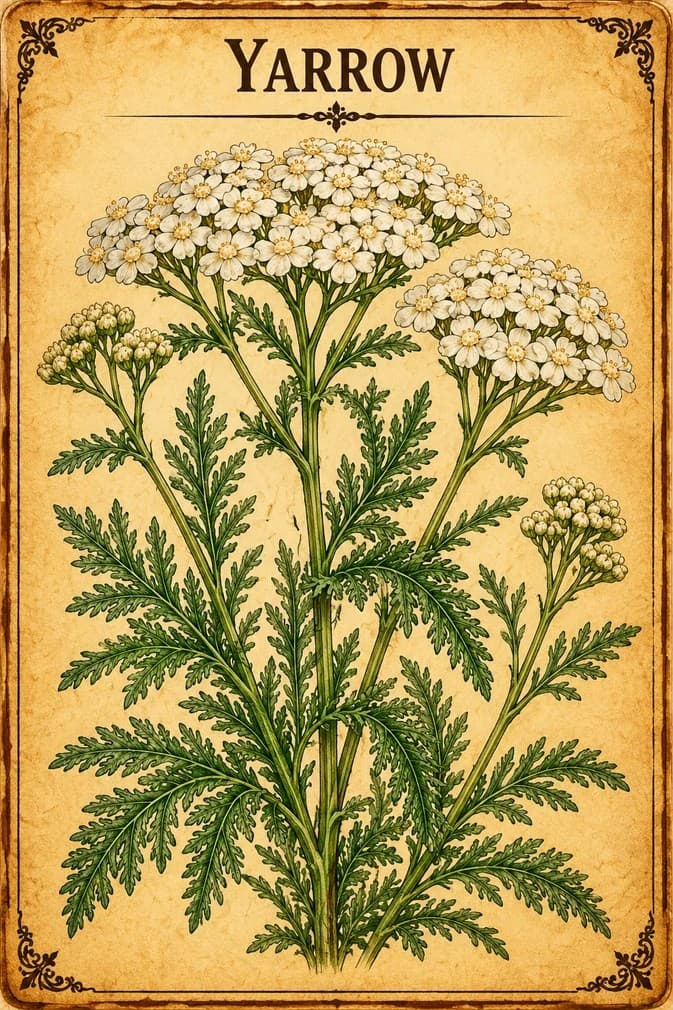
Yarrow
Achillea millefolium
An herb recognised in Europe as a traditional remedy for loss of appetite, mild digestive problems, period cramps and small wounds.
Safety at a glance
- Pregnancy1 note →
- BreastfeedingNothing recorded
- MedicinesNothing recorded
- Who should avoid it1 note →
- Allergies1 note →
- ToxicityNothing recorded
Tap a box to read the safety notes below. “Nothing recorded” means our sources don't cover it, not that it's safe.
What is Yarrow?
- Plant family
- Asteraceae, the daisy family
- Parts used
- The flowering above-ground parts, as a tea, a liquid or tablet to take by mouth, or soaked dressings for the skin
- Genus
- Achillea
- Species
- millefolium
Also called
Milfoil, Yarrow Herb
Traditionally used for
- Appetite
- Digestion
- Bloating
- Period cramps
- Small wounds
Traditionally described as
- May ease cramps
Health topics
Where Yarrow appears in symptom search, and why. Being listed doesn't mean it's a proven treatment.
- Bloating
Recognised in Europe as a traditional remedy for bloating and gas.
- Cuts, Wounds, Burns and Skin Ulcers
Recognised in Europe as a traditional remedy for small, shallow wounds.
- High Cholesterol
In one trial in type 2 diabetes, yarrow capsules lowered LDL and total cholesterol.
- Indigestion
Recognised in Europe as a traditional remedy for mild digestive problems.
- Loss of Appetite
Recognised in Europe as a traditional remedy for temporary loss of appetite.
- Menstrual Discomfort
Recognised in Europe as a traditional remedy for minor period cramps.
Traditions that use it
- European Folk Medicine
Recognised in Europe as a traditional remedy for appetite, digestion, period cramps and small wounds.
How it's prepared
Common ways Yarrow is prepared or sold. This isn't advice on how to take it; see Safety below.
- Extract
Dry and liquid extracts, and juice pressed from the fresh plant, are taken by mouth.[1]Health agency
- Poultice
The fresh or dried herb is applied to wounds to help stop bleeding.[2]General reference
- Tea / Infusion
The dried flowering plant is made into an herbal tea to drink, or steeped to make a wash for the skin.[1]Health agency
- Tincture
Yarrow tinctures (alcohol extracts) are taken by mouth.[1]Health agency
Safety
Who should avoid it
Only for adults and teenagers over 12.[3]Health agency
Allergies
Don't use yarrow if you're allergic to it or to other plants in the daisy family (Asteraceae). Allergic skin reactions have been reported.[3]Health agency
Pregnancy
Its safety during pregnancy and breastfeeding hasn't been established, so the European Medicines Agency doesn't recommend yarrow medicines at these times.[1]Health agency
How much to use
See a doctor if appetite or digestive problems last more than 2 weeks, or if period cramps or wounds don't improve within 1 week.[3]Health agency
What does the research say?
Traditional use
These are traditional uses, not proven treatments.
The European Medicines Agency recognises yarrow as a traditional herbal medicine, based on long use, for:
- Temporary loss of appetite
- Mild digestive problems, including bloating and gas
- Minor belly cramps during periods
- Small, shallow wounds (put on the skin)
Research in people
In a 2025 Iranian trial, 60 people with type 2 diabetes took 500 mg of yarrow a day or a dummy capsule for 3 months. Yarrow lowered liver enzymes, triglycerides, LDL ("bad") cholesterol and total cholesterol.[4]Study
In a 1-year Iranian trial, 75 people with multiple sclerosis took yarrow extract (250 or 500 mg a day) or a dummy pill alongside their usual treatment. Both doses lowered the yearly relapse rate, and the higher dose reduced growth of brain lesions on scans. It's a single small trial.[5]Study
In a trial of 80 women with vaginal yeast infections, a yarrow vaginal cream used for 7 days reduced symptoms, but the standard antifungal cream (clotrimazole) worked better.[6]Study
In short
Don't use if you're allergic to plants in the daisy family; only for those over 12.
Sources
- [1] European Union herbal monograph on Achillea millefolium L., herba (Revision 1) — European Medicines Agency, Committee on Herbal Medicinal Products (HMPC)Government health agency
- [2] Yarrow — Herban Herbalist materia medica — Herban Herbalist (herb shop)General reference
- [3] Millefolii herba (yarrow herb): herbal medicinal product summary — European Medicines Agency (EMA), Committee on Herbal Medicinal ProductsGovernment health agency
- [4] Achillea millefolium capsule improved liver enzymes and lipid profile compared to placebo in patients with type 2 diabetes: a double-blind randomized clinical trial · DOI: 10.1186/s40795-025-01005-5Peer-reviewed study
- [5] Achillea millefolium is beneficial as an add-on therapy in patients with multiple sclerosis: A randomized placebo-controlled clinical trial · DOI: 10.1016/j.phymed.2018.06.017Peer-reviewed study
- [6] The effect of Achillea Millefolium L. on vulvovaginal candidiasis compared with clotrimazole: A randomized controlled trial · DOI: 10.1016/j.ctim.2020.102483Peer-reviewed study
This information is educational and traditional in nature, and is not a substitute for professional medical advice. Unfamiliar word? See what these words mean.