
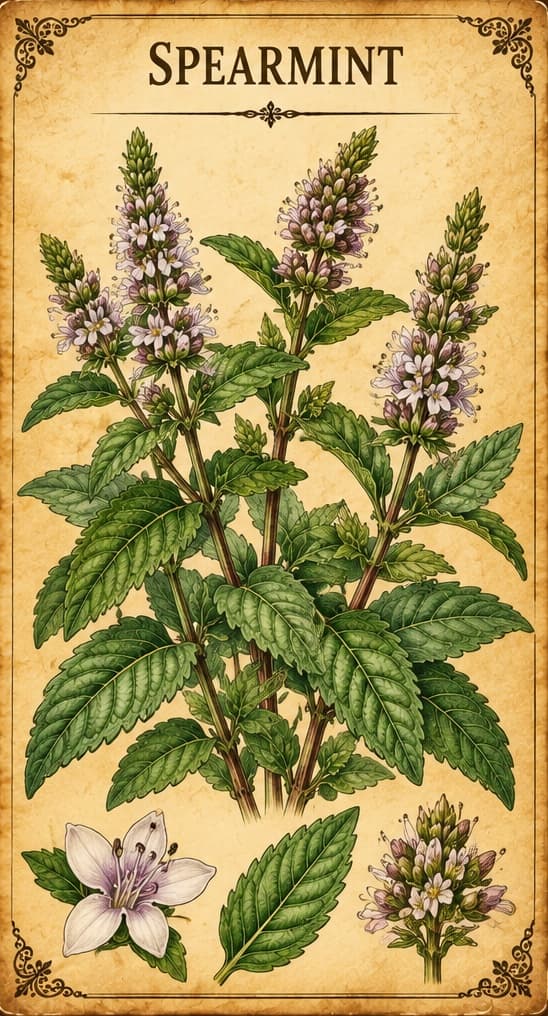
Spearmint
Mentha spicata
A mint grown worldwide as a flavoring and tea, traditionally used for colds, coughs and digestive problems. Small trials suggest spearmint tea may lower testosterone in women with PCOS, and an extract may slightly help memory and attention.
Safety at a glance
- PregnancyNothing recorded
- BreastfeedingNothing recorded
- MedicinesNothing recorded
- Who should avoid itNothing recorded
- AllergiesNothing recorded
- Toxicity2 notes →
Tap a box to read the safety notes below. “Nothing recorded” means our sources don't cover it, not that it's safe.
What is Spearmint?
- Plant family
- Lamiaceae, the mint family
- Parts used
- The leaves and stems above ground, as tea, extract or essential oil
- Genus
- Mentha
- Species
- spicata
Traditionally used for
- Flavoring
- Tea
- Colds (traditional)
- Digestion (traditional)
- Excess hair growth in PCOS (small trials)
- Memory (small trials)
Traditionally described as
- May lower testosterone (small trials)
- Antioxidant (in lab studies)
Health topics
Where Spearmint appears in symptom search, and why. Being listed doesn't mean it's a proven treatment.
- Asthma and Wheezing
A traditional remedy for asthma. Not tested in trials; asthma needs medical care.
- Colds and Nasal Congestion
A traditional remedy for colds. Not tested in trials.
- Cough
A traditional remedy for cough. Not tested in trials.
- Fever
A traditional remedy for fever. Not tested in trials.
- Indigestion
A traditional remedy for digestive problems. Not tested in trials.
- Memory and Thinking
Two trials funded by its maker found a spearmint extract slightly improved working memory in older adults with mild memory problems, and attention in younger adults.
- Sleep Problems (Insomnia)
In one trial funded by its maker, older adults taking 900 mg of a spearmint extract said they fell asleep more easily than with a placebo.
How it's prepared
Common ways Spearmint is prepared or sold. This isn't advice on how to take it; see Safety below.
- Capsule
In one trial, a spearmint extract was taken as capsules with breakfast.[1]Review or trial
- Tea / Infusion
Herbalists steep 1 to 2 teaspoons of the herb in a cup of boiling water.[2]General reference
- Tincture
Herbalists use it as a tincture.[2]General reference
Safety
Side effects
Spearmint is generally recognized as safe as a flavoring. In a 90-day trial, 600 or 900 mg a day of a spearmint extract didn't cause more side effects than a placebo, and it didn't change hormone or blood test results.[3]Study
Toxicity testing
In rats given very strong spearmint tea as their only drink for 30 days, it damaged the kidneys, and the harm was worse at the higher strength. These rats drank it all day for a month, and the effect hasn't been shown in people.[4]Study
Technical detail: 20 g/L and 40 g/L Mentha spicata tea; raised plasma urea and creatinine; tubular degeneration.
A matching rat study found liver damage from the same strong spearmint teas, worse at the higher strength.[5]Study
Technical detail: granular or ballooning hepatocyte degeneration and necrosis at 20 and 40 g/L.
What does the research say?
Traditional use
These are traditional uses, not proven treatments.
Spearmint is grown worldwide for its scent and as a food flavoring. It has traditionally been used for:
- Colds, cough, asthma and fever
- Digestive problems
- Jaundice
- Weight problems (obesity)
Laboratory & animal research
Lab and animal results show what might be worth studying in people. They don't show that the herb has these effects in humans.
In lab and animal studies, spearmint extracts and essential oil killed some bacteria and fungi, acted as antioxidants, lowered inflammation and helped protect the liver. The review's authors say clinical trials in people are needed to back up these traditional uses.[6]Study
Research in people
In a small Turkish study, 21 women with excess body hair (hirsutism), 12 of them with polycystic ovary syndrome (PCOS), drank a cup of spearmint tea twice a day for 5 days. Their free testosterone, a male-type hormone, went down. There was no comparison group.[7]Study
Technical detail: taken in the follicular phase; free testosterone fell and LH, FSH and estradiol rose; total testosterone and DHEA-S didn't change significantly.
In a UK trial, 42 women with PCOS and excess body hair drank spearmint tea or a placebo herbal tea twice a day for 30 days. Spearmint lowered testosterone, and women felt they had less unwanted hair. But a doctor's rating of hair growth didn't change. The author says a longer study is needed, because hair takes time to respond.[8]Review or trial
Technical detail: randomized, two centers; 41 of 42 completed; free and total testosterone fell (p < 0.05); LH and FSH rose; modified DLQI improved (p < 0.05); Ferriman-Gallwey score unchanged (p = 0.12).
In a US trial, 90 adults (average age 59) with mild memory problems linked to aging took 900 mg or 600 mg of a spearmint extract, or a placebo, every day for 90 days. At 900 mg, working memory improved by about 15% compared with placebo, and people said they fell asleep more easily. The extract's maker funded the study and employed some of the authors.[1]Review or trial
Technical detail: double-blind, placebo-controlled; extract high in rosmarinic acid; quality of working memory +15% (p = 0.0469), spatial working memory accuracy +9% (p = 0.0456).
In a US trial, 142 healthy, active younger adults took 900 mg of the same spearmint extract or a placebo daily for 90 days. Those taking spearmint did slightly better on attention tests. Mood, sleep and quality of life didn't change. Several authors worked for the extract's maker.[9]Review or trial
Technical detail: randomized, double-blind, placebo-controlled; sustained attention day 30: 33.3 vs 31.2 (P = .001), day 90: 34.0 vs 32.7 (P = .007).
In short
Safe as a flavoring, but very strong spearmint tea damaged the kidneys and liver of rats.
Sources
- [1] Spearmint Extract Improves Working Memory in Men and Women with Age-Associated Memory Impairment — Journal of Alternative and Complementary Medicine · DOI: 10.1089/acm.2016.0379Review or clinical trial
- [2] Spearmint — Herban Herbalist materia medica — Herban Herbalist (herb shop)General reference
- [3] Safety and tolerability of a dried aqueous spearmint extract — Regulatory Toxicology and Pharmacology · DOI: 10.1016/j.yrtph.2017.03.005Peer-reviewed study
- [4] Investigation of biochemical and histopathological effects of Mentha piperita L. and Mentha spicata L. on kidney tissue in rats — Human & Experimental Toxicology · DOI: 10.1191/0960327103ht332oaPeer-reviewed study
- [5] Investigation of biochemical and histopathological effects of Mentha piperita Labiatae and Mentha spicata Labiatae on liver tissue in rats — Human & Experimental Toxicology · DOI: 10.1191/0960327104ht412oaPeer-reviewed study
- [6] The traditional uses, phytochemistry and pharmacology of spearmint (Mentha spicata L.): A review — Journal of Ethnopharmacology · DOI: 10.1016/j.jep.2021.114266Peer-reviewed study
- [7] Effect of spearmint (Mentha spicata Labiatae) teas on androgen levels in women with hirsutism — Phytotherapy Research · DOI: 10.1002/ptr.2074Peer-reviewed study
- [8] Spearmint herbal tea has significant anti-androgen effects in polycystic ovarian syndrome. A randomized controlled trial — Phytotherapy Research · DOI: 10.1002/ptr.2900Review or clinical trial
- [9] The attention-enhancing effects of spearmint extract supplementation in healthy men and women: a randomized, double-blind, placebo-controlled, parallel trial — Nutrition Research · DOI: 10.1016/j.nutres.2018.11.012Review or clinical trial
This information is educational and traditional in nature, and is not a substitute for professional medical advice. Unfamiliar word? See what these words mean.