
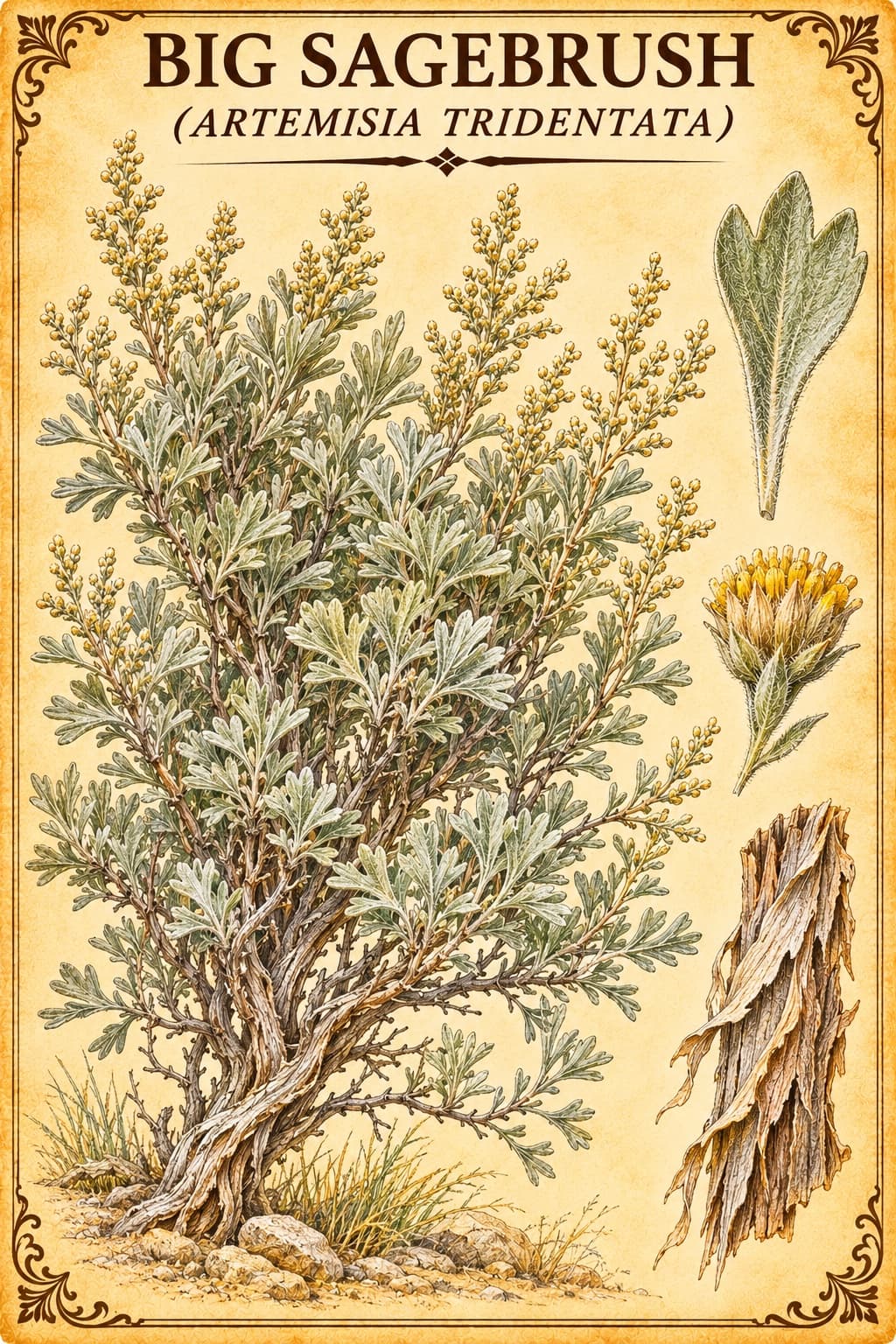
Big Sagebrush
Artemisia tridentata
The great sagebrush of the American West, called chamiso in northern New Mexico. It was one of the most widely used Native American remedies for colds, coughs and upset stomachs.
Safety at a glance
- Pregnancy2 notes →
- BreastfeedingNothing recorded
- MedicinesNothing recorded
- Who should avoid itNothing recorded
- Allergies1 note →
- Toxicity1 note →
Tap a box to read the safety notes below. “Nothing recorded” means our sources don't cover it, not that it's safe.
What is Big Sagebrush?
- Plant family
- Asteraceae, the daisy family
- Parts used
- The leaves and leafy branches
- Where it grows
- Western North America
- Genus
- Artemisia
- Species
- tridentata
Also called
Sagebrush, Desert Sage
Regional names
Chamiso, Chamiso Hediondo
Traditionally used for
- Colds
- Coughs
- Indigestion
- Wounds (traditional)
Traditionally described as
- Aromatic leaves rich in camphor
Health topics
Where Big Sagebrush appears in symptom search, and why. Being listed doesn't mean it's a proven treatment.
- Colds and Nasal Congestion
One of the most widely used Native American cold remedies, as a tea or steam. Not studied in people.
- Cough
A leaf tea was taken for coughs by many Western peoples. Not studied in people.
- Fever
A leaf tea was taken to cause sweating and break fevers. Not studied in people.
- Indigestion
Leaves were chewed or made into tea for indigestion and stomach cramps. Not studied in people.
- Sore Throat
The Shoshoni gargled a leaf decoction for sore throats. Not studied in people.
Traditions that use it
- Native American Ethnobotany
Used by more than 20 peoples, including the Paiute, Shoshoni, Navajo, Zuni, Tewa, Hopi, Washo, Klamath and Okanagan-Colville.
Natural compounds
How it's prepared
Common ways Big Sagebrush is prepared or sold. This isn't advice on how to take it; see Safety below.
- Poultice
Hot or mashed leaves and branches put on aches, swellings and sores.[1]Traditional text
- Tea / Infusion
Leaf tea taken for colds, coughs, fevers and indigestion.[1]Traditional text
Safety
Allergies
Big sagebrush pollen contains an officially recognized allergen (Art t 1), from the same group as the main allergen in mugwort pollen. Artemisia pollen is a major cause of hay fever.[2]Study
Pregnancy
A Taos herbalist advises not using chamiso (big sagebrush) during pregnancy.[3]General reference
A Thompson elder recorded in the ethnobotany database said the tea was too strong to drink, warning that it could stop a woman from having more children.[1]Traditional text
Toxicity testing
Sagebrush essential oil is considered toxic.[4]Study
What does the research say?
Traditional use
These are traditional uses, not proven treatments.
Big sagebrush was one of the most widely used medicines of the West, especially for colds. The Paiute, Shoshoni, Washo, Zuni, Kawaiisu and many other peoples drank a tea of the leaves for colds, coughs, flu and fever, and breathed the steam or smoke for head colds and headaches.[1]Traditional text
The Paiute, Shoshoni, Tewa and Hopi chewed the leaves or drank the tea for indigestion and stomach cramps. The Klamath and Northern Paiute took it for diarrhea, and the Shoshoni gargled it for sore throats.[1]Traditional text
The Paiute and Shoshoni washed cuts, wounds and sores with a leaf decoction, bathed newborns in it, and used the powdered leaves as baby powder. Hot poultices of the branches were put on aching joints and muscles, and the Zuni put leaves in shoes for athlete's foot.[1]Traditional text
Many peoples burned the branches to purify homes, sweathouses and sickrooms, and the Paiute and Shoshoni gave a tea of the plant as a tonic after childbirth.[1]Traditional text
In northern New Mexico, big sagebrush is called chamiso (not to be confused with chamiso saltbush). A local herbalist recommends a tea of the dried leaves, sipped before meals, as a bitter to help digestion, and for coughs and menstrual cramps.[3]General reference
Laboratory & animal research
Lab and animal results show what might be worth studying in people. They don't show that the herb has these effects in humans.
The leaves contain an aromatic oil that can be up to 45% camphor, along with eucalyptol and alpha-pinene. In a 2022 study, sagebrush oils didn't have significant effects against germs, malaria or leishmania parasites.[4]Study
In a 1967 lab study, big sagebrush oil slowed the growth of several bacteria, including Staphylococcus aureus; E. coli was the most resistant.[5]Study
In short
The essential oil is toxic; avoid in pregnancy. Its pollen is a known allergen.
Sources
- [1] Native American Ethnobotany Database: Artemisia tridentata — Botanical Research Institute of Texas (BRIT); compiled by Daniel E. MoermanTraditional text
- [2] Allergic Potential of Medicinal Plants From the Asteraceae Family · DOI: 10.1002/hsr2.70398Peer-reviewed study
- [3] Herb of the month: Chamiso — The Taos NewsGeneral reference
- [4] Essential Oil Yield, Composition, and Bioactivity of Sagebrush Species in the Bighorn Mountains · DOI: 10.3390/plants11091228Peer-reviewed study
- [5] Antibacterial action of essential oils of Artemisia as an ecological factor. I. Antibacterial action of the volatile oils of Artemisia tridentata and Artemisia nova on aerobic bacteria · DOI: 10.1128/am.15.4.819-821.1967Peer-reviewed study
This information is educational and traditional in nature, and is not a substitute for professional medical advice. Unfamiliar word? See what these words mean.