
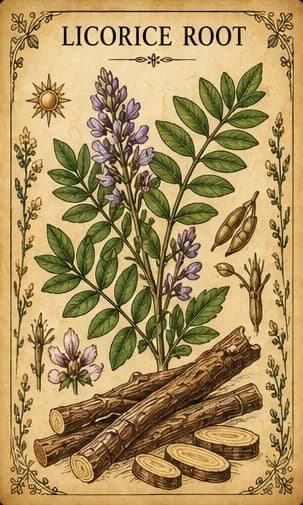
Licorice
Glycyrrhiza glabra
A root used since ancient times in Egyptian, Greek, Chinese and Indian medicine for coughs, asthma and wounds. Recognized in Europe for cough with a cold and for indigestion, but too much can raise blood pressure and upset heart rhythm.
Safety at a glance
- Pregnancy1 note →
- BreastfeedingNothing recorded
- Medicines1 note →
- Who should avoid it1 note →
- AllergiesNothing recorded
- Toxicity1 note →
Tap a box to read the safety notes below. “Nothing recorded” means our sources don't cover it, not that it's safe.
Licorice may interact with some medicines. If you take any medicine, read Interactions with medicines below and talk to your doctor or pharmacist before using it.
What is Licorice?
- Plant family
- Fabaceae, the pea and bean family
- Parts used
- The root
- Where it grows
- Grown across Europe, Asia and the Middle East
- Genus
- Glycyrrhiza
- Species
- glabra
Also called
Licorice Root, Liquorice, Glycyrrhiza uralensis, DGL
Traditionally used for
- Cough
- Sore throat
- Indigestion
- Heartburn
Traditionally described as
- May help loosen mucus
Health topics
Where Licorice appears in symptom search, and why. Being listed doesn't mean it's a proven treatment.
- Chest Congestion and Bronchitis
Recognized in Europe to help bring up phlegm. Watch for effects on blood pressure and potassium.
- Cough
Recognized in Europe as a traditional medicine to help bring up phlegm with a cough from a cold.
- Eczema
Limited evidence suggests licorice may possibly help eczema.
- Indigestion
Recognized in Europe as a traditional medicine for heartburn and indigestion.
- Sore Throat
Studies suggest it may ease sore throat after a breathing tube is removed; evidence is limited.
Traditions that use it
- European Folk Medicine
Recognized in Europe as a traditional medicine for cough with a cold and for heartburn and indigestion.
- Traditional Chinese Medicine
Used historically for coughs, asthma, wounds and lung, liver and artery diseases.
Natural compounds
How it's prepared
Common ways Licorice is prepared or sold. This isn't advice on how to take it; see Safety below.
- Decoction
Herbalists simmer 1 to 2 teaspoons of the dried root in a cup of water. The root is also added to tea blends for sweetness.[1]General reference
- Extract
Soft extracts of the root are used in liquids to take by mouth.[2]Health agency
- Tea / Infusion
The dried, cut root is made into an herbal tea.[2]Health agency
- Tincture
Herbalists use it as a tincture.[1]General reference
Safety
Interactions with medicines
Licorice can work against blood pressure medicines. Don't take it with water pills, heart medicines such as digoxin, steroid medicines, stimulant laxatives or other medicines that affect potassium. It may also change levels of medicines broken down by the liver enzyme CYP3A4, such as midazolam and omeprazole.[2]Health agency
Who should avoid it
Licorice medicines aren't recommended if you have high blood pressure, kidney, liver or heart disease, or low potassium. Don't take them with other licorice products: this can cause fluid retention, low potassium, high blood pressure and heart rhythm problems. Not recommended under 18.[2]Health agency
Pregnancy
Eating large amounts (about 250 g a week) during pregnancy is unsafe and raises the risk of premature birth. Licorice medicines aren't recommended during pregnancy, for women who could become pregnant without contraception, or while breastfeeding.[2]Health agency
Toxicity testing
Licorice contains glycyrrhizin, which can cause serious problems, including an irregular heartbeat and cardiac arrest, especially in large amounts or with long-term use. Even small amounts can be risky if you eat a lot of salt or have high blood pressure, heart disease or kidney disease.[3]Health agency
Depends on how it's prepared
Deglycyrrhizinated licorice (DGL), which has the glycyrrhizin removed, appears safe for up to 4 months.[3]Health agency
What does the research say?
Traditional use
These are traditional uses, not proven treatments.
Based on long-standing use, the European Medicines Agency recognizes licorice root as a traditional herbal medicine for adults:
- To help bring up phlegm with a cough from a cold
- To relieve digestive symptoms such as a burning feeling and indigestion
Licorice was used in ancient Assyrian, Egyptian, Greek, Arab, Chinese, Tibetan and Indian medicine for coughs, asthma and wound healing, and for diseases of the lungs, liver and arteries. Today it is promoted for digestive, breathing and energy support.[3]Health agency
Research in people
Evidence is limited. Studies suggest licorice may help mouth ulcers (canker sores) and sore throat after a breathing tube is removed after surgery, and possibly eczema. There's no good evidence it helps COVID-19.[3]Health agency
In short
Large amounts or long-term use can cause high blood pressure, low potassium and dangerous heart rhythms.
Sources
- [1] Licorice — Herban Herbalist materia medica — Herban Herbalist (herb shop)General reference
- [2] European Union herbal monograph on Glycyrrhiza glabra L.; Glycyrrhiza inflata Bat.; Glycyrrhiza uralensis Fisch., radix, Revision 1 (EMA/HMPC/108399/2024) — European Medicines Agency, Committee on Herbal Medicinal Products (HMPC)Government health agency
- [3] Licorice Root: Usefulness and Safety — National Center for Complementary and Integrative Health (NIH)Government health agency
This information is educational and traditional in nature, and is not a substitute for professional medical advice. Unfamiliar word? See what these words mean.